
The Lord said to Moses, “This is the land of which I swore to Abraham, to Isaac, and to Jacob, saying, ‘I will give it to your descendants’; I have let you see it with your eyes, but you shall not cross over there.”
That reading from Deuteronomy 34:1-12 is terrifying to me. God has made Moses a leader for his people – given him a purpose and a mission. Moses had faced down a Pharaoh, led his people through years of wandering in the desert, and has finally caught a glimpse of the goal of their long journey of a generation.
But Moses would not be the leader to enter the Promised Land with Israel.
It’s a frightening prospect to anyone who hopes to accompany people through thick and thin, people they’ve become fond of. That’s a frightening prospect to a United Methodist pastor, who itinerates from congregation to congregation every few years or so. It’s a frightening prospect to me.
It’s a reminder to me that it’s not what the clergy want to happen that ultimately comes to pass. If it had been Moses’ choice, he would have seen his people through to their deliverance. After all, it was Moses who got them into the mess in which they found themselves; we all would want to see that journey to its conclusion.
But churches last longer than their preachers. The cornerstone of this church, placed just a few feet from the pulpit, marks the year 1884. Next year, 140 years will have passed from the occasion of laying that stone. And how different it is today from what it was a century ago. Congregations change: they flourish, they flounder, they get back up again. What would one of its first leaders think of Howard Chapel-Ridgeville UMC? And from my perspective, I can only wonder at what God will do with this congregation in the next year, or in the next decade, or in the next century.
That’s the thing about churches. They’re full of surprises, because they’re full of people, and people do unexpected things. And that’s exactly what God wants from us – to listen to God’s gentlest promptings, to imagine just what could be, and to take a risk and try something new, something that we wouldn’t undertake on our own, something that is frightening.
God is often inviting us to leave our comfortable homes, our familiar patterns of life, for something else that’s better down the road. God is inviting us to see things from a different perspective, and God’s plans for us are often frightening to us. Today is the Sunday before Halloween, and the emphasis on frightening can have more than one meaning today. So maybe, in the spirit of All Hallows’ Eve, we can embrace the frightening nature of God and follow God’s promptings, as willingly as we embrace the festivities, masks, parades, and treats of the holiday.
Because God never stops inviting us to try something new, to see the world differently, and to imagine what might come next.
That’s exactly the kind of God that we fear. It’s scary to contemplate the end of things we have grown to know and to love. It’s uncomfortable and undesirable to begin to believe that what is next for you and me is something untested and untried, unsure and unstable. The religious people of Jesus’ day were unwilling to try something different. Jesus asked them: “What do you think of the Messiah? Whose son is he?” They said to him, “The son of David” (Matthew 22:34-46).
The messiah, they hoped, would be just like they remembered their revered and idolized king of the past. And “the son of David” is a loaded phrase. It meant the one who takes after David, born of the Davidic line, a celebrated warrior, a winner of battles, a leader and a poet, a beloved son of Israel.
Zealots in Jesus’ day fancied themselves as sons of David, and they led rebellions big and small against the Roman Empire, which occupied their land. The Pharisees yearned for a true son of David to redeem Israel, to overthrow the powers which threatened their wellbeing, and to make them a secure and united people again. They wanted a warrior and a political leader.
But Jesus confronted the Pharisees for their ambitions, their nationalism, their hatred of Romans and foreigners, their misplaced hope in pining for a past, familiar hero to come their way again. The world was no longer as it was when David ruled.
Jesus, the true son of David, the very Son of God, would not overthrow Rome. But he would overthrow the forces of doubt, despair, and apathy, the grip of greed, violence, and sin. Jesus would not make Israel a great nation. But he would make them a light to the nations.
In Christ’s own self-emptying of his power and authority, in his own self-giving out of love for others, Jesus redeems more than the Pharisees could have imagined, more than the disciples could have imagined, more than the Church in the centuries since has imagined, more than you and I will ever imagine. That is the kind of new thing that God does. That is the kind of God the Pharisees feared, a God whom we fear as well. If we’re not careful, we’ll live our whole lives afraid of this God.
It’s my prayer that we learn to approach God and hear God’s gentlest promptings. We can start by looking for God in the quietest places in our hearts.
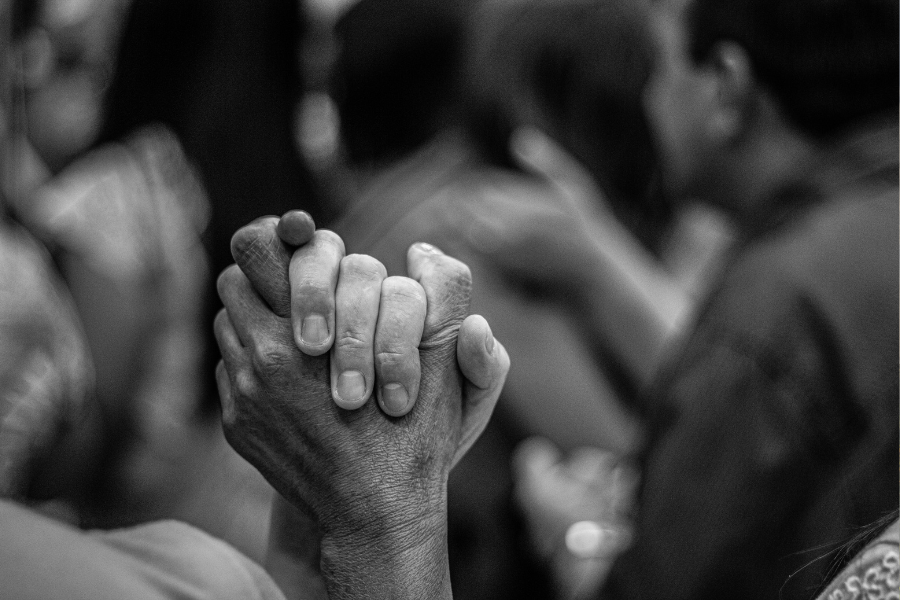
There’s a kind of quietness there, which I think we may miss if we’re not on the lookout for it. Because I think that silence is an important way to deal with life, its joy and its tragedy – holding your loved ones’ hands in silence, praying to God with your emotions rather than words and phrases, which always seem too small to bear what’s inside.
The problem is that we avoid silence, because it can make us uncomfortable. With each year’s innovation we find ways to become more distracted by our smart phones, more connected to the news, and more immersed in the conversation. We’re good at distracting ourselves from ourselves. We’re good at distracting ourselves from silence.
But in moments of silence, we can look inside ourselves. With God keeping us company, we can be brave. We can examine our subtle thoughts and discover more about who we are. We can begin to unearth the most powerful truth, one covered and disfigured by the traumas and tragedies of our lives. We can reclaim our identity from the cruelty of words spoken in anger and the callousness of actions taken in haste. We can reveal to ourselves and to the world the enduring beauty of how deeply we are loved and how much dignity rests within our hearts.
What changes that would make in the world, I can only imagine. And, I realize, I can’t fathom what miracles of God would be seen in a world filled with people who know how beloved they are, how noble they are, how strong and kind they are. A world like that would see far fewer instances of violence and destruction, hostility and hatred. You and I can’t imagine how wonderful that would be. It is worth every effort to seek God in the silence of our hearts.
May your moments in silence, if you can manage them, bring you a sense of peace over something you haven’t been able to let go of. May the silence which sits all around us give you the space to learn that it is alright for you to be you, that you are graced by God to be created and redeemed, formed and reformed, into the person you are this minute, and the person you will be in the next.
May you discover that God sees you and finds nothing lacking, nothing missing, nothing holding you back – but instead welcomes you just as you are to receive blessing and healing as a child of God. May silence fill you with God’s acceptance of you, so that you may live each day to the full.
May you act on that discovery. May you act this week on the discovery that you are a child of God. Better than a son of David, you are a child of God. May your seven days of quiet moments fill you with wonder – wonder at what God has given you. And may you act. After sitting in the quiet moments between all of your appointments and commitments, may you be moved to act.
May your actions, which were once frightening and foreign, untried and untested, unsure and unstable, become your own expression of faithfulness in a God who is always inviting us to try something new, to leave our comfortable homes, our familiar patterns of life, for something else that is unimaginably better.
I invite your response. Amen.

Leave a Reply