
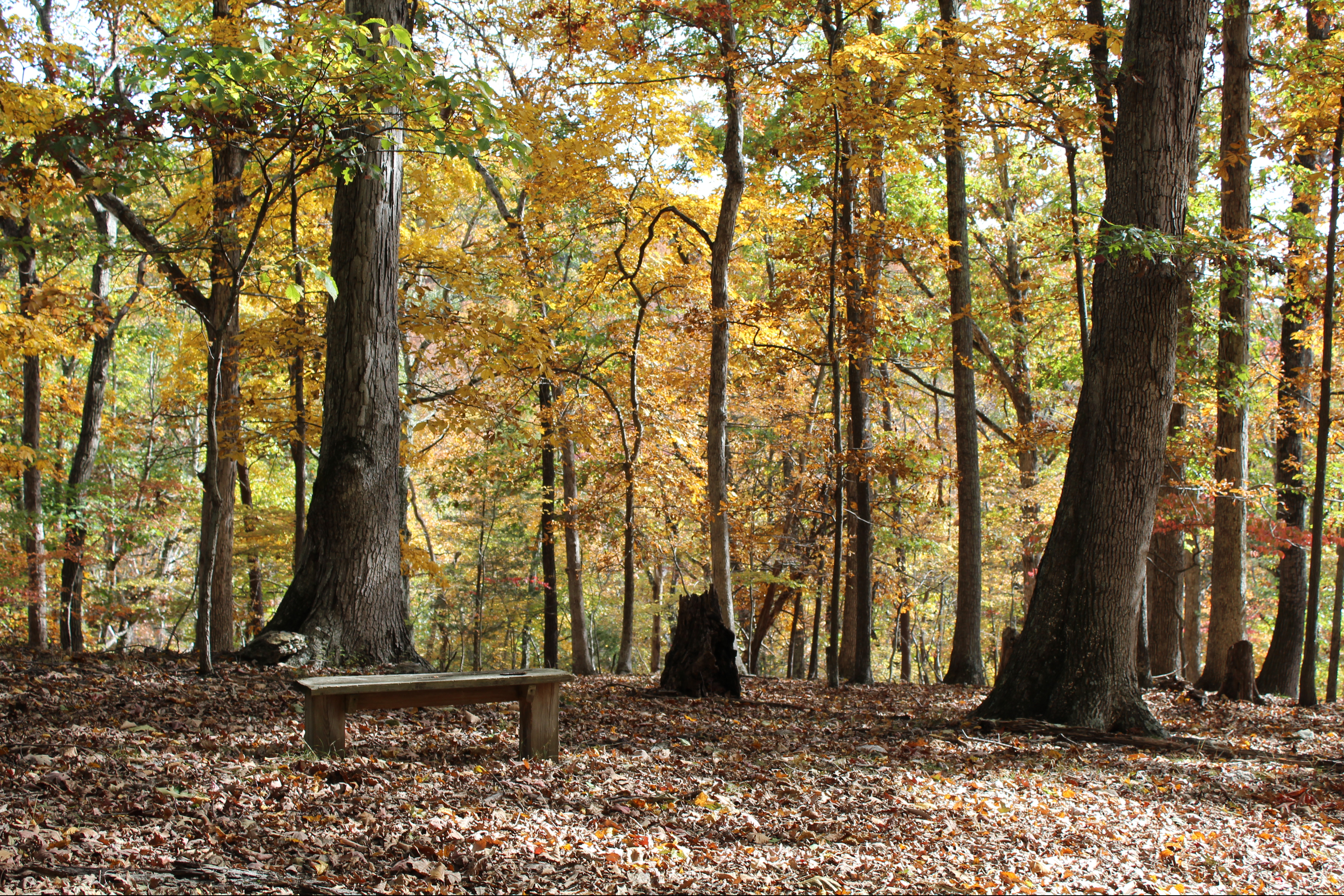
Every year, on November 1, with the characteristic cold of the season settling in, I reread this poem from Mary Oliver. Perhaps you’ve read it, too.
Don’t you imagine the leaves dream now
how comfortable it will be to touch
the earth instead of the
nothingness of the air and the endless
freshets of wind? And don’t you think
the trees, especially those with
mossy hollows, are beginning to look for
the birds that will come—six, a dozen—to sleep
inside their bodies? And don’t you hear
the goldenrod whispering goodbye,
the everlasting being crowned with the first
tuffets of snow? The pond
stiffens and the white field over which
the fox runs so quickly brings out
its long blue shadows. The wind wags
its many tails. And in the evening
the piled firewood shifts a little,
longing to be on its way.[i]
Mary Oliver, “Song for Autumn” in Poetry (May 2005)
The changing of the leaves, the chill in the air, the long days fading into long nights, all serve as signs to us that God created, and intends for, everything to change, to become something new, and for hardly anything at all, to remain the same – always and forever.
The wildfires will spend all their fuel. The hurricanes will wind down. The days of pandemic and plague will come to an end. The waves of social acrimony will one day effect change, from the lowest valley to the highest tower, here and throughout the world. The violence and destruction by the powers and principalities (Romans 8:38) will one day give way to the peace and flourishing of the Beloved Community.[ii]
Nothing is forever. It is a statement of hope to people who are suffering, who have been wondering for generations if their lives matter. It is a declaration to “the powers that be,”[iii] that their time is limited, that – even if they call themselves Caesar – they are still mortal; they are still frail. To the tyrant, the people rejoice in saying that the tide changes, and empires fall.[iv]
But the constancy of change means also that the lives of those we love ultimately come to an end, and we see them no more. We embrace them no more. We hear their laugh in the other room, but now only in our memory. Change brings grief.
Grief can be an awful specter to stare down. We can try to hide from it. We can try to ignore it. We can try to deny that we are affected by loss. But it is just a fact that it is hard to lose someone we love. I think it’s also hard to lose someone whom we struggled to love, that we have to resign ourselves to the foregoing of closure, the impossibility of reconciliation.
It can be a dark place to find ourselves – mourning and grieving – a “thin place between the living and the dead.”[v] And maybe that’s why we mark the lives of the saints on a day like All Saints, the midpoint between the equinox and the solstice, a holy day after summer’s end. For centuries, a vigil of prayer and supplication has been held on this day.
And for us, still recovering from a plague we found we could not fight, and a pandemic of hate which has enslaved us for far too long, “the scale of our losses is such that we need to look back,”[vi] to that practice of vigil, of keeping watch, of looking up into the night sky for God’s presence, and holding out hope that we are listened to and understood.
Seeing and walking in the dark is not something we have to invent for ourselves, all on our own. We join a long tradition of faithful people who have allowed God to lead them through uncertainty and into life, even in the valley of the shadow of death (Psalm 23). As one modern day saint reflects:
If I have any expertise, it is in the realm of spiritual darkness: fear of the unknown, familiarity with divine absence, mistrust of conventional wisdom, suspicion of religious comforters, keen awareness of the limits of all language about God and at the same time shame over my inability to speak of God without a thousand qualifiers, doubt about the health of my soul, and barely suppressed contempt for those who have no such qualms. These are the areas of my proficiency.[vii]
Maybe you have felt the same way – fearful, alone, mistrustful, suspicious, limited, ashamed, doubtful, and contemptuous. Maybe you have walked through a season of grief. Maybe your grief has lingered longer than you imagined it would. Or maybe you’ve been wary of letting yourself experience grief at all, worried you’d be overwhelmed by what you found, or discovered lurking in your heart. Maybe it’s something else you’re avoiding, which, after a summer of sunshine, is coming up to the surface on days like today.
Maybe you’ve felt like something was always missing growing up, that you felt like you were struggling on the inside, just trying to tread water, while others around you seemed to be thriving on the outside. Maybe you tried to find something to grab onto, to help you feel less overwhelmed – by piles of dishes to wash, or school lessons to learn, or work demands, or loneliness (even surrounded by so many peers, but still not connecting as friends).
Where did you find your hiding place? A beloved priest and writer, admitted to a gathering that hiding made him feel like a wayward child, explaining: “I am the prodigal son every time I search for unconditional love where it cannot be found,”[viii] in dysfunction, addiction, abuse, neglect – searched for but never grasped, because we never looked for it from God, who is not far, but dwells within us. Maybe we looked for elsewhere, because we were scared that we would be rejected, even by God. And, like Adam and Eve in the Garden, we hid (Genesis 3).
How long did you hide, trying not to feel overwhelmed, as you progressed through life – through school, through work, through relationships, through failures, and through successes? Perhaps it felt like a double life, until your hiding became a problem in and of itself.
To hide is to be disconnected (from others, from nature, from a sense of meaning and purpose, from God and everything that is sacred). It is to be empty and in pain, to be lacking. If nothing matters but hiding from life and choosing the emptiness that comes from disconnection, then we will end up filling that emptiness however we can. I’ve mentioned them before: food, drink, possessions, hatred, shame, despair, control, worry, and despondency – until we are trapped and, upon waking, we echo the words of Paul: “I do not understand my own actions. For I do not do what I want, but I do the very thing I hate” (Romans 7:15).
What would you tell someone living in a trap like that? What would you tell your younger self if you’ve gone through that kind of dark pilgrimage in your life? What would you tell your son or daughter, your sibling, your closest friend, if you saw that she was hiding from life for fear of facing the grief and pain which follow change?
You might say, as I often do at a funeral, what Jesus said to the crowds, as he sat down to teach:
Blessed are the poor in spirit, for theirs is the kingdom of heaven. Blessed are those who mourn, for they will be comforted.
(Matthew 5).
Blessed are you who feel burdened by shame, who are brave enough to admit fault when you realize it or when others name it for you. Blessed are you who allow yourselves to mourn, who are courageous to face your grief rather than run from it. Blessed are you who are gentle, not abusive or manipulative, but patient and longsuffering; you are resilient, and you are wise, and you are needed in this world.
Blessed are you who seek justice in your lives and in your community, because justice only is attained when advocated and worked for; it does not grow on its own. Blessed are you who can see the humanity and limitation of others and not hold it against them; may you also be as gracious to yourselves. Blessed are you who seek after God’s way of seeing the world, because you will be able to see God in the people around you – all belonging to the same Creator and all bearing God’s image.
Blessed are you who seek reconciliation with others, because in that way you know the heart of Jesus Christ. Blessed are you when you face resistance in the world, because then you are walking in the light of God.
Blessed are you, because God made you. The One who crafted heaven and earth out of light and brought form to chaos to plant a Garden also knows your name, and calls you now to find peace in the love of Jesus Christ and the grace of the Holy Spirit – peace from God, which passes all understanding (Philippians 4:7).
That’s what I would say to anyone listening at a funeral. That’s what I would pray for you to know in your heart on the days when you cry and on the days when you laugh.
And speaking to you, this day, in this moment, I invite you to choose your response to God’s invitation – to leave your hiding behind and to seek God’s peace by walking through the pain and grief of life, which is always becoming something new.
I invite your response. Amen.
[i] Mary Oliver “Song for Autumn” in Poetry (May 2005).
[ii] C. Anthony Hunt, January 11, 2017: https://www.churchleadership.com/leading-ideas/ten-ways-build-beloved-community/
[iii] Walter Wink, The Powers That Be: Theology for A New Millennium, 1999.
[iv] “You’ll Be Back,” Hamilton, sung by Jonathan Groff, written by Lin-Manuel Miranda, 2015.
[v] Kate Bowler, https://www.instagram.com/p/CG3JdlLsGEV/
[vi] Ibid.
[vii] Barbara Brown Taylor, Learning to Walk in the Dark
[viii] Henri J.M. Nouwen, Return of the Prodigal Son

Leave a Reply