
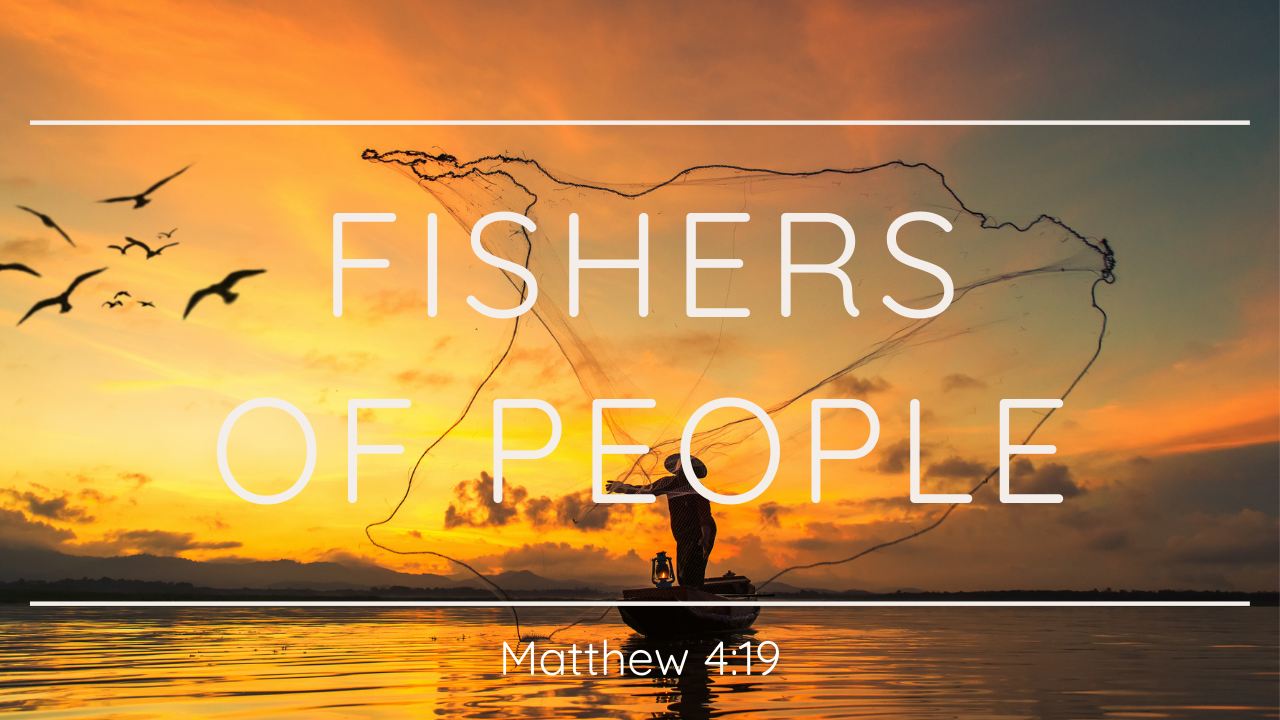
Early in the Gospel story, Jesus withdraws to Galilee and makes his home in Capernaum. Matthew is keen to point out that Jesus is in the territory of Zebulun and Naphtali, in fulfillment of the scriptures. The Book of Isaiah tells of a people who sat in darkness who have seen the light dawn upon them. In the prophet’s day, it was the promise of deliverance from Israel’s occupation by the Assyrians. Now in Jesus’ day, under Roman occupation, the dawning light would be understood as the beginning of Christ’s ministry, of fishing people out of despair and despondency, resentment and rage.
No matter the age, the world can get pretty dark. And, in these winter months, when even the sun itself doesn’t climb as high in the sky, we look to the horizon for light to dawn again. What that light would look like might be different for different people. We are divided, as ever, on what to call good and what to call evil. Perhaps we even see in each other what Israel saw in the Romans and, earlier, the Assyrians – unrepentant, unaccountable, unforgivable. Do you know about Nineveh, the capital city the empire? It’s real.
“The ruins of Nineveh lie along the Tigris River in what is now northern Iraq. Founded by Nimrod, it was the last capital of the Assyrian Empire. In the book of Jonah, God sends Jonah to Nineveh to prophesy against it, resulting in the city’s surprising conversion. The Prophet Nahum announced the coming destruction of Nineveh because of its cruelty to other nations. Nineveh fell to the Babylonians in 612 B.C.E., and it has remained in ruins to this day.”
The Assyrian Empire subjugated Israel in the ninth century B.C. and, in the next century, conquered and exiled many of the people of Israel to the regions near the Tigris and Euphrates Rivers. The city of Jerusalem almost fell. This was the time the prophet Isaiah lived. This is the deep darkness he describes.
Can you imagine being a prophet? You’d live as a mouthpiece for God, telling truth to power, crying out for the needs of the oppressed, the broken-hearted, the captives, and the prisoners (Isaiah 61:1), proclaiming the year of God’s salvation and comfort to all who mourn (v. 2), calling all people to lead lives of righteousness and holiness.
Maybe you’d also want to condemn the evil in your sight, the people who look, to you, like they’re from Nineveh, like they’re the wrongdoers, like they’re the ones who stormed the city walls and breached the gates. They’re the ones who threatened to rape your family. Maybe you’d want to do what the other prophet Jonah did, and declare: “Forty days more, and Nineveh shall be overthrown!” That is a resentful and raging, unforgiving way to live. Holding onto a grudge and carrying a chip on your shoulder, as you surely know, will only tire your more quickly and wear you down more profoundly.
That way of living is rooted in pain. If you have ever felt such a pain, you might relate to Jonah and to the people of classical Israel. Has your heart ever been weighed down by the atrocities committed against you and your people for centuries? Have you had to learn how to live with a wound that is generations-deep and will not heal and cannot be treated with a balm or bound up with a bandage? Is there any way to go about your life after you’ve been assaulted and dehumanized? I can’t fault Jonah for failing to forgive the Ninevites. I’m doubtful I ever could if what befell his people befell mine, too.
For us today, we are, as a country, almost evenly divided, very much struggling to “see each other not as adversaries, but as neighbors.” It’s tempting for us to view all who are different from us the way Jonah sees Nineveh – beyond redemption, too far gone for God’s grace.
But his story casts a different light on our story, I think. However we see the world, whether we align with progressives or conservatives, however much we struggle to recognize the common humanity of our neighbor, who thinks differently from us, we are not wronged, quite as much as Jonah’s people have been wronged. I think it should be easier for us to see in each other our shared qualities and values. I think we can manage it and that God calls for it. So, however much I resist God’s calling in my life, however I delay it, I can see a lot of myself in Jonah as he did everything he could to resist God as well.
Instead of walking East to Nineveh, Jonah sailed West. But I imagine God spoke to Jonah on that boat, because he tried hard to sleep, to stop hearing the voice of God, to stop hearing his conscience, feeling regret, accepting the pain of his people, and seeing the wrongdoers as deserving – even after they had been so unfathomably unkind.
That Jonah was so fast asleep despite the great storm which threatened the ship on the sea, to me implies he was not just tired. He was drunk. He was unconscious. He was trying to break from this world, to break from reality, to run away completely.
And he did. He did it by suggesting the sailors throw him overboard. That way, he didn’t take his own life. That way, he died as a faithful and self-sacrificing person. It was a pious way to die, in the name of preserving the lives of the crew. But it was also bitter. He hated the Ninevites so much that he would rather stop talking and breathing altogether than to go to them to utter a word of warning – just warning – warning and a call to repentance. What would he have done if God had asked him to speak a gracious word to them as well?
Maybe you can recall a time when God had asked you to speak a gracious word to someone. Maybe that word was never voiced. Maybe you had a hard time conjuring empathy and invoking sympathy within yourself. Maybe you have heard too few words of grace in your life.
Jonah didn’t hear a word of grace from God in the dark depths of the sea. He experienced grace, unmediated and direct, unexpected and incomprehensible.
In the belly of a great fish, in the raging waters, cast away from a ship sailing as far as it could from Nineveh, away from where God had sent Jonah, away from his calling, away from his God, Jonah prayed (2:2-9):
I called to the Lord out of my distress, and he answered me;
out of the belly of Sheol I cried, and you heard my voice.
You cast me into the deep, into the heart of the seas, and the flood surrounded me;
all your waves and your billows passed over me.
Then I said, “I am driven away from your sight;
how shall I look again upon your holy temple?”
The waters closed in over me; the deep surrounded me;
weeds were wrapped around my head at the roots of the mountains.
I went down to the land whose bars closed upon me forever;
yet you brought up my life from the Pit, O Lord my God.
As my life was ebbing away, I remembered the Lord;
and my prayer came to you, into your holy temple.
Those who worship vain idols forsake their true loyalty.
But I with the voice of thanksgiving will sacrifice to you;
what I have vowed I will pay. Deliverance belongs to the Lord!
God fished Jonah out of the deep darkness of despair and dread, resentment and rage. And God fishes for people all the time.
Crying out for help is what we do when we finally give up, when we realize we have drowned so deep that we cannot swim to the surface, we cannot put down an addiction, we cannot heal ourselves of our own wounds from generations-old trauma. We cry out for help when we are drowning. And God lifts us up out of the waters. Out of the chaos of the world, from under the face of the deep, we are salvaged, we are saved, we are caught in a net of God’s own making, and pulled into a boat of salvation, in the open air and in the light of day once more. God fishes us out of the Pit, out of Sheol, out of Hades and Hell, out of the prisons of our own making. God rescues us from despair and despondency, resentment and rage.
And then, rescued, we have a choice. We can hoard our salvation for ourselves. We can keep our good news a secret. We can continue to resist God’s call to go to Nineveh. We can run from it, ignore it, and try to make our way through life, giving thanks for being rescued, but never rescuing another. We can choose never to learn to swim, always crying out to be fished out of the water.
Or, we can take up Jesus’ invitation, the one shared with Simon and Andrew, James and John, and by extension, all the disciples, all the Christians of all the ages, all the prophets, all the martyrs, all the saints, and you and me – an invitation to leave behind our usual way of doing things, to put down our grudges, to follow Christ, and to be made into fishers of men, fishers of people, to do what God does – hoisting the drowning in the dark and the deep, lost to the waters of despair and despondency, resentment and rage.
You know them. They’re drowning in their own living rooms, alone and tired. They’re drowning in their own dependencies, their own bad habits, their own mechanisms for coping. People are drowning in their pain and in their brokenness, which drive them further and further away from reality, away from their families, away from God, as the waters of deep darkness close in over their heads. People are drowning.
What would it take for you and me to fish for people? What would it take for you and me to throw out a net into the sea and uplift others? What would it require of you and me to pull someone into the boat, into Christ’s ark of salvation, into the Church, into a community of hope and humility, peace seeking and grace giving?
Maybe we could pray for the people in our lives we see drowning. Maybe we could allow ourselves to feel God leading us to reach out to them, to tell them how much they are loved – not only by their Creator but genuinely by us, as well. Maybe we could befriend them, listen to them, and hear their stories. Maybe we could feel what they feel, have compassion for them, and let them know they are not alone.
Maybe the would begin to feel like they could breathe again. Maybe they would start to feel like they were able to open their eyes and see the sun again, to be able to see the world around them, God’s Creation as it is, and their Creator beholding them.
What if they were able to open up for the first time about a wrong they endured? What if they were able to begin to believe the world wasn’t ending because things weren’t going their way? What if they were able to take a step toward recovery? What if they were able to live again? Can you imagine what would happen if you fish them out of the waters?
I would love to hear about it.
I invite your response.
Amen.

Leave a Reply