
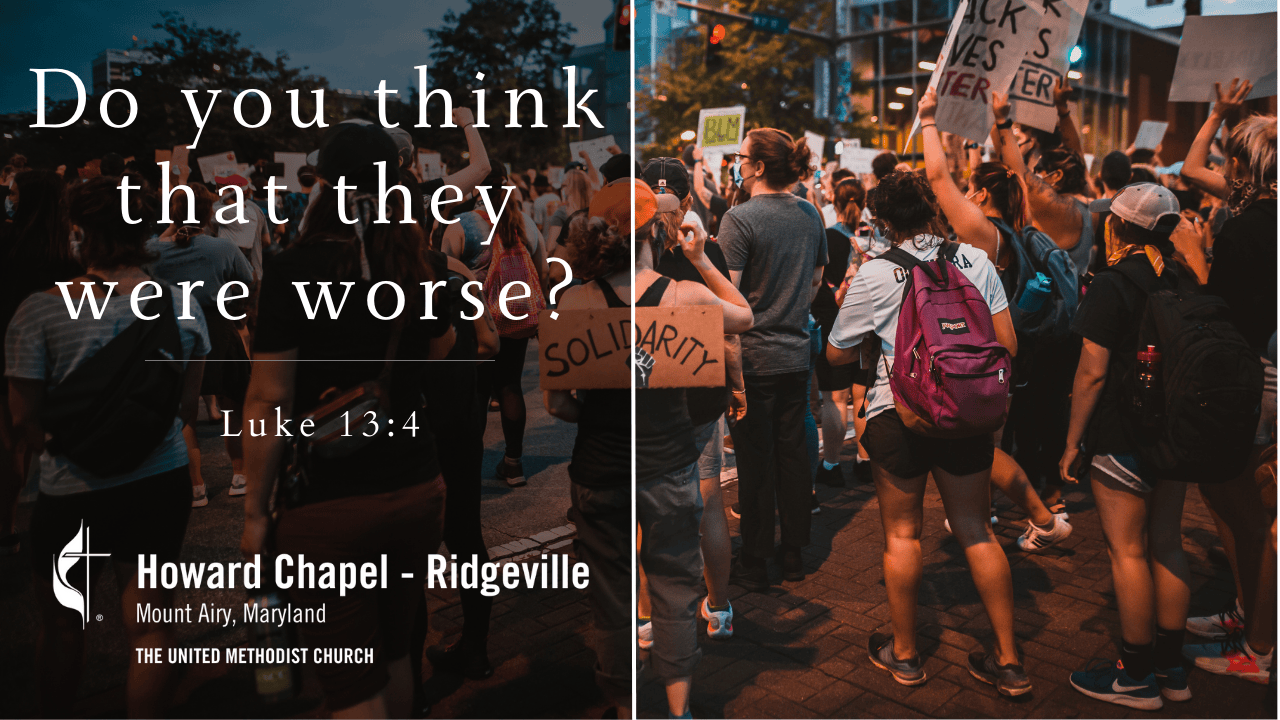
Today, we’re gathered for another service, one week since we last met together. It might not feel like this to you, but to me, it feels like a lot has happened over the course of the week: Social unrest, protests and vandalism at Tesla showrooms around the country, intimidation and censoring of universities,[i] the removal of references to heroes in the US military who were not white or male,[ii] anonymous threats sent to the homes of dissenting Supreme Court justices (even the ones appointed by the President),[iii] mass deportations in violation of court orders,[iv] the dissolution of federal agencies,[v] pillaging private and personal information from the Social Security Administration and the IRS,[vi] more mass firings in the government, and growing unemployment in our communities. I want to hide from it, I want to fast forward through the next several years. I’m not sure if my heart can take all the ups and downs. But then I ran across a poem[vii] by one poet, Rosemerry Wahtola Trommer, who in her wisdom wrote:
“For When People Ask”
I want a word that means
okay and not okay,
more than that: a word that means
devastated and stunned with joy.
I want the word that says
I feel it all all at once.
The heart is not like a songbird
singing only one note at a time,
more like a Tuvan throat singer
able to sing both a drone
and simultaneously
two or three harmonics high above it—
a sound, the Tuvans say,
that gives the impression
of wind swirling among rocks.
The heart understands swirl,
how the churning of opposite feelings
weaves through us like an insistent breeze
leads us wordlessly deeper into ourselves,
blesses us with paradox
so we might walk more openly
into this world so rife with devastation,
this world so ripe with joy.
So much sudden change, unvarnished controversy, and economic volatility[viii] can be numbing for us.[ix] We know from past years that we can grow accustomed to it. And, in a way, we have to, in order to fall asleep at the end of the day, in order to wake up at the start of the next, in order to care for children and grandchildren, to offer stability and patience to others, when it is most needed and is also in such short supply. It’s a necessity, which we’ve been practicing at, for a decade now.
But complacency is also a danger in its own right. If things return to what we might consider normal at some point, will we be able to begin processing the surprise and shock that will have gotten pent up? Will we be able to release the pressure incrementally and in stages, and feel more and more deeply the weight of the world? I genuinely hope so.
But I’m worried we will be tempted to hide from this gathering dismay, instead holing ourselves up in our numbness, refusing to contemplate the loss of what we thought was unassailable and inalienable, walling off the part of us that has been asked to patiently wait until all this over. I’m worried we will try to forget everything we’ve been through, in the rush to smile and laugh and hug again.
I’m worried we will be tempted to gloss over the deaths of millions of people from the pandemic of the century, as well as the suffering of millions more, and the struggles and disruptions experienced by billions. I’m worried we will not adequately mourn the wellbeing of those on the margins, because we are daunted by the scope of our collective trauma and the world’s enormity. I’m worried we will be tempted to focus only our own small circles of friends and family, and we will fail to see all people as so beloved that it makes the prospect of losing them unbearable.
I’m worried we will wall off our hearts from tragedy and forego altogether the truth that comes from holding in our hands and in our hearts the painful paradox – that we have ideals and values which are being affronted and dismantled by scofflaws, and, nevertheless, our society is still capable of being made whole again and again and again.[x] If we’re vulnerable, if we’re open to it we can even find company and consolation on the way.
Will we cut off our capacity for empathy out of fear of losing our sanity? Or will we be brave enough to care for people who don’t look like us, don’t vote like us, don’t talk like us, don’t live like us, but who are still bearers of the image of God, just like us?
Ultimately, it comes down to how we answer the question Jesus poses in the Gospel. The people who are targeted, people bearing the ethnicities and orientations and nationalities and even political views that are demonized – how deeply do we care for them? Do we mourn their trials and tribulations? Do our hearts go out to them?
Or do we think that our tranquility and comfort matter so much that we cannot take time to pause, to allow ourselves to see a little more clearly, the sacred worth of a stranger and a foreigner, someone who is different from “us?” And what does that word mean – “us?” Are we a homogenous group? Have you forgotten I lived here under a green card until my parents naturalized our citizenship when I was 17? Is it because I don’t have an accent that it’s so easy to forget that I lived in five countries before I was five years old? What does the word us mean, really? And do we think that somehow “they” are worse than “us?” Do we think that their cause does not deserve our attention?
The people who lose their lives in encounters with police officers, do they matter to us? Their protest movement, memorialized in the pavement on 16th Street, is being removed and resurfaced. But neighborhoods around the city are drawing the same letters in chalk.[xi] And what about the people who are denied due process, or the people whose memorials are so scandalous they are televised – do we think they should not be protected? Do we struggle to accept their plight as inevitable?
Or do we think that they were worse? Are we hiding from the possibility that we will lose our capacity for happiness and fulfillment if we open ourselves to compassion? Are we worried there isn’t enough love or goodness in God’s creation to make it possible for us to follow Jesus’ call and mission to care for our neighbors, to love our neighbors, all of our neighbors? Are we even choosing to insist that empathy is weakness,[xii] and are we forsaking the cross?
Wouldn’t you rather believe in a God who intends for us to find our lives when we consent to lose them, to receive grace and peace when we offer it selflessly to others? Wouldn’t you rather come to worship a Jesus Christ, our Savior, “who, though he was in the form of God, did not regard equality with God as something to be exploited, but emptied himself, taking the form of a slave, being born in human likeness. And being found in human form, he humbled himself and became obedient to the point of death—even death on a cross. (Philippians 2:5-8). Isn’t that the kind of God we want to worship? A selfless God?
This God loves us. “Someone has testified somewhere, ‘What are human beings that you are mindful of them, or mortals, that you care for them? You have made them for a little while lower than the angels; you have crowned them with glory and honor” (Hebrews 2:6-7). God loves all of us. And we are invited to see the people who are like us and the people who are not like us as our brothers and sisters, our siblings one and all, their value and worth unquestioned.
Do we allow ourselves to feel the pain of others, in order to come to terms with our connection to them? Or do we ignore the tragedy? Unless we make sure to feel the weight and potential of a life, and of every single life, a part of us perishes. A part of our humanity is lost. A part of the spark that comes from God is obscured.
I invite you to consider if there is anyone whom you deem as worse than you, as less deserving of love and acceptance than you. Write it down, on a small slip of paper, and keep it on your nightstand, and pray to God for God’s will for them. What does God want for them? What does God want for you?
This season of repentance, this preparation for the miracle of Easter, this Lent, may we all be brave, even through our fears, to face with open eyes the tragedies which people are enduring, so that we can be ready to bear the grace of God’s unyielding love with our whole selves – healing not only our wounds, but the wounds of the whole world.
Amen.
[i] https://apnews.com/article/columbia-protests-immigration-detention-mahmoud-khalil-755774045e5e82849e3281e8ff72f26d
[ii] https://www.facebook.com/share/p/1A1WSg94Cc/
[iii] Heather Cox Richardson, March 20, 2025, Facebook, https://www.facebook.com/share/p/1Yy4XRpHQ8/
[iv] Ibid.
[v] Ibid.
[vi] Ibid.
[vii] https://ahundredfallingveils.com/2022/03/13/for-when-people-ask/
[viii] https://www.bu.edu/articles/2025/markets-turn-volatile-what-should-you-do/
[ix] Steve Inskeep, “The List of School Shootings Just Keeps Growing. Do We Still Feel Anything?,” NPR, February 15, 2018, https://www.npr.org/2018/02/15/585971934/deadly-florida-school-shooting-is-the-latest-added-to-the-list
[x] Erin Qualey, “A Trauma Therapist on What WandaVision Gets Right,” Slate, March 3, 2021, https://slate.com/culture/2021/03/wandavision-trauma-recovery-i-may-destroy-you-flight-attendant.html
[xi] https://www.popville.com/2025/03/new-blm-plazas/
[xii] https://www.npr.org/2025/03/22/nx-s1-5321299/how-empathy-came-to-be-seen-as-a-weakness-in-conservative-circles

Leave a Reply