
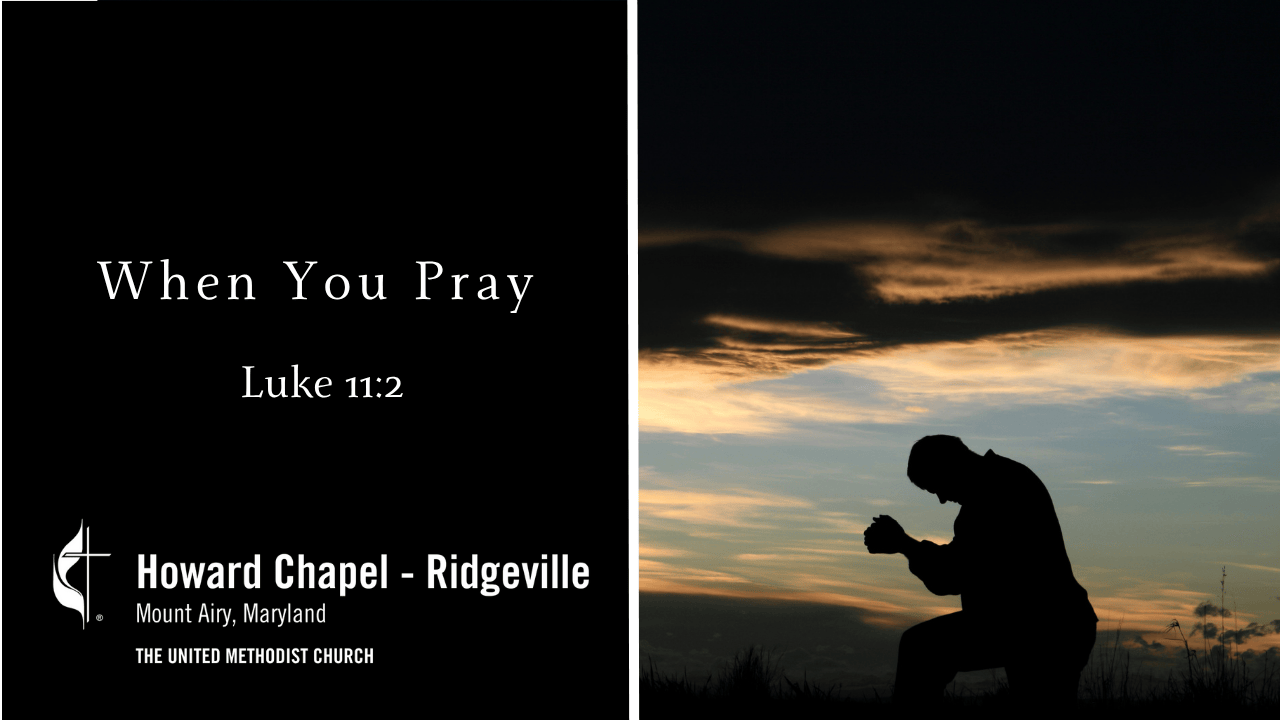
Jesus is asked by the disciples to teach them to pray. And he responds, with a word so brief we might miss it, with a challenge more piercing than we are prepared to face, “When you pray…”
When. Not if you pray, not if you believe in the power of prayer, not if you can find time as you rush to head out the door in the morning, not if you can take a break from your responsibilities during the day, not if you have energy as the twilight fades into the soothing deep darkness of night. He says when: When you pray. How often do we actually pray? When do we pray?
Jesus doesn’t have to lie to the disciples that he himself prays often; they see it. The passage itself begins with prayer. Jesus “was praying in a certain place,” and the disciples knew well enough not to bother him, not to interrupt him, not to pester him while he was in prayer, not to complain to him about which disciple started a dispute and which disciple was slacking off. They waited until he was done, and one of the disciples asked Jesus, “Lord, teach us to pray.”
Prayer is turning inward. It’s seeing yourself, like taking a step back from being in the moment to observing yourself being in the moment. You can take a step back from that as well and be aware of yourself just being aware. Becoming more aware is helpful for us. We can analyze our habits of thought and word. We can pause to reflect why we do the things we do. We can entertain the possibility of change in our behavior and personality.
Maybe you can remember a period when you’ve wanted to change who you are. Right now I’m going through one. I’d like to be better at playing with my children. With my younger son, I can entertain him and make him laugh. We have a great time, even if it’s just going shopping for groceries.
With my older son, I tend to flounder trying to come up with some activity or silliness. I’m more serious with him. I’m somehow convinced that it’s more important that I teach him, tell him, demonstrate for him with words how much he means to me. I find myself wanting to show him the world, to conjure on my phone and my computer videos for him to watch. I want him to see volcanic eruptions, newly discovered insects, and images of blackholes lightyears away from us.
Now, an insecurity has grown in me that I’m not as fun with him. I’ve wondered if something was lacking in my childhood, if I didn’t have as many examples of how to be fun, how to relax, how to laugh. And I’ve found myself worrying, wanting to change my behavior and personality, and afraid that I can’t.
But this week, I saw my friend playing with his kids at the pool. My sons joined in. Children tossed a beach ball, playing keep away from the monkey in the middle. My friend, a father of my son’s classmate, was the monkey. He entertained a dozen kids from four-years-old to nine-years-old, as he comically leapt for the ball each time it was passed. For almost ten minutes not a single other parent had to worry about refereeing an argument or finding a snack in their bag.
I wasn’t jealous of my friend. I was in awe. I would never put myself in that position. It would never occur to me to be so boisterous. And I began to wonder what kind of upbringing he had that would give him the power to let loose, to play as a parent so lightheartedly and wholeheartedly.
I shared with him that I was really impressed by how well he could parent his children and be a playmate when called upon. And he explained to me: He was the oldest of seven children. In my envy, I instantly imagined he grew up in some large farmhouse with a dozen people dwelling in each other’s company. But his childhood wasn’t idyllic. His parents had struggled to be supportive of each other and had divorced when he was three-years-old. They each later remarried. They each had more children. And then his parents divorced a second time.
My friend’s childhood was characterized by uncertainty, disruption, grief, and reinvention in the midst of unfamiliarity. He built a capacity for playfulness and affection out of the upheavals and disappointments he faced as a child. He grew beyond his background to become a source of joy to his loved ones and an inspiration to his neighbors, like me.
Though my friend didn’t have a perfect childhood, he isn’t lacking some key ingredient or some vital experience from his past in order to be the kind of person he wants to be. He doesn’t dwell in excuses or settle for half-measures. He is miraculously grounded in his identity, as one both beloved and loving, both patient and forgiving, hopeful and inspired.
I share his story with you, because it’s my belief that we all can find our way to live as we wish we could live, to love as fully and freely as both our loved ones and strangers around the world need us to. We don’t have to have a perfect past. We don’t need an unbroken heart to live tenderheartedly. We can move beyond our backgrounds to be a different kind of people, a holy people, a people who are rooted in reality and optimistic about our options. That’s what it means to be connected to God and to reveal God to others in our actions and in our presence.
To find our shelter in the truth of things rather than assemble a fortress out of our delusions, I think what it requires is for us to take moments of silence in the midst of our day, when we are busy and careworn, when we are frazzled or upset, when we would rather not stop because we are finally making progress in some project or in some goal. We must adopt a pattern of stopping, perhaps for five minutes out of every thirty.
Instead of reflexively reacting to a setback, instead of resorting to an engrained predisposition or to retreating to an outdated rationalization, instead of telling ourselves nothing will ever be different, we can pause and look inside ourselves without flinching. We can step back from the moment. Accompanied by God, we can be more aware. We can discover more about who we are, we can be reminded of how deeply we are loved, and we can imagine how much dignity rests within our hearts.
In growing in our awareness, we become more connected to the experiences of others around us. We begin to see more clearly our own “unique talents, strengths, sense of purpose, core values, beliefs and desires.”[i] We practice with each pause, with each period of silence. We learn what triggers our reactions. And we can become more understanding, more aware, of how others’ unique qualities drive them. Seeing ourselves, seeing others, and seeing the whole of creation more completely, we can be a peaceful presence, we can be a refuge of equanimity, we can be a new creation – all by praying. What a worthy undertaking. What will your answer be if someone asks you when you pray?
[i] Avolio, B.J., & Gardner, W.L. (2005). Authentic leadership development: Getting to the root of positive forms of leadership. The leadership quarterly, 16(3), p. 324.

Leave a Reply