
There was once a man who loved his family but couldn’t bring himself to believe what they believed. He didn’t quite fit in. There must have been hard days. There must have been days when he wanted to leave everything behind. Maybe there were even days when he felt like burning his life to the ground. But one day, his father passed away, and in that moment, he felt unglued from the world around him. He felt untethered. He felt like he could finally leave, and be whatever he wanted to be, believe whatever he wanted to believe.
As he contemplated his next steps, he got news there was a rabbi, a revolutionary, a prophet, a messiah, who was walking through his town on the way to Jerusalem, on the way to the city of kings, on the way to the Temple of God. This couldn’t be just chance, right? So the man listened to the teacher, the rabbi who was rejected by town after town, but whose words still carried meaning, and whose presence was compelling.
The man without a father said to Jesus, who had “set his face to go to Jerusalem,” that he would follow Jesus out of that town, out of his old life, and into something new, on some new adventure, to an unknown place, where maybe things were better – a better religion, better company, a better life. But first, he had to grieve his father, to put the life he had hated behind him, to say goodbye once and for all to the town he had lived in and had grown to loathe and despise.
But Jesus said to him: “Let the dead bury their own dead; but as for you, go and proclaim the kingdom of God.” Go back to your family. Go back to your loved ones. Go back to the villagers you’ve given up on. Go back to the memories that are hard for you to tolerate. Go to the center of the things you find irredeemable. And there, when you are surrounded by everything you think is so far from the God of the cosmos, there, when you are face-to-face with a broken and heartbreaking world, there, when you cannot ignore or gloss over or whitewash or sugar coat what is in front of you, there, even when you are so ready to leave it behind, or to let it all burn down around you, there and in that place, proclaim the kingdom of God.
Proclaim what it looks like when God is in control, when God is king. God brings us together. God brings us together for worship, God brings us together to support one another after a death, God brings us together to help rebuild after a natural disaster. Because things are better when we’re together, when God is in control, when the reign of God has come near.
We know what things are like when people act like there is no God. They behave with vindictive insolence, attacking each other out of revenge and disregard. This world is full of hatred and self-interest. People treat strangers with fear and suspicion, terrified that their deepest prejudices would be confirmed. This world is full of fear. Others, still, pursue destruction and death as they hunger for power by intimidation. This world is full of destruction.
For some reason, we think that posturing, causing division, and casting blame are what it means to be in the right, to be authentically faithful. In this world of ours, we believe that if we can tell people what to do with their time, their energy, their choices, their power, then we can finally be happy. We believe that by taking away other people’s agency, by imposing our own control, we can make the whole world right. We believe that by acting like God, we can do better.
But I’d like to share with you an alternative, one which you already honor since you make time in your week to spend in worship with a community of faith, a community of people who have ideas and experiences which are different from yours. Instead of striking out on our own, when we have problems listening for God’s voice, we might be able to hear it better if we listened to the stories of those we would prefer to ignore or belittle. In the face of all our selfishness and self-centeredness, the kingdom of God is characterized by God’s action of reconciliation and God’s abiding love for creation. And we are invited to be reconciled with one another, to bear one another in love.
The United Methodist doctrine of the Body of Christ affirms the “diversity inherent within it (1 Corinthians 12), as opposed to the thought that we ought to all live out our faith in Jesus Christ in exactly the same way,” as a fellow pastor put it. As a church, we have a particular vision of God’s reign in the world. This vision involves us; we get to participate in God’s kingdom. We are called to pray for God’s kingdom to come, on earth as it is in heaven (Luke 11:1-4). And in that way, our prayer is both supplication and submission; by God’s grace, we will order our lives so that God’s will might be done through our actions and in our words.
Praying that God’s will might be done also invites us to see the world differently. We ask for God to be God in our lives and in our world, and we do not despair that God will ignore our plea. Instead, we begin to expect to see God at work! In reframing our narrative from one of hopelessness to one of a present-and-still-coming victory, we become increasingly attuned to God’s presence and work around us.
God’s reign is more than just a shift in perspective. But reframing the story of the kingdom of God all around us can mean all the difference in our experience of God, in our life. How we see the world impacts how we behave in it, so that God’s reign might be made manifest in our actions as well as in our hearts.
That’s what we’re doing when we come together. We support those who have experienced calamity and destruction – be it an act of trauma and violence, an unspeakable loss of a classroom of children, a forest fire, a hurricane, an earthquake, or a war. By giving of ourselves, we point to the source of hope and redemption in our lives that can help others rebuild and restart their own. And in giving of ourselves to strangers, we may end up crowding out what traces of violence, fear, and destruction still linger in our hearts. We may find in ourselves only enough room to support, inspire, and encourage the people around us.
With God in control, we can begin to look like a community, like the beloved community. With God reigning in our lives, we can help each other make it through the tribulations and trials of each day and year. With God, we can all do our part to help those in despair.
That’s why for me, gathering with you Sunday to Sunday, is an honor. And standing with you today, at the end of my second year with you, I know that I’m not perfect, that I’m not a perfect pastor, not a perfect family member, not a perfect anything. But I also know that I am ruled by a faith in Jesus Christ, a Lord and Savior who has touched my life, a gift of grace which has touched yours as well.
I think that “rules” is a good word to describe the power of Jesus. It’s not ruling with punishment doled out to those who dissent. No fire is cast down upon any village that rejects Christ. But for us, to be part of the Kingdom is to be completely aligned with it – to hold nothing back. That’s what it means to be fit for the kingdom – to give of ourselves completely. In the hymn, “Rejoice, the Lord Is King,” we declare:
His kingdom cannot fail;
he rules o’er earth and heaven;
the keys of earth and hell
are to our Jesus given.
I believe that when Christ holds us in his hands, we may even feel we have no choice but to lift up our voice and rejoice at God’s plan of salvation for our lives. I think that that’s liberating: We don’t have to fret anymore about whether or not we’re worthy of God’s love, worthy of loving our neighbor, worthy of loving ourselves. God’s already decided for us! And it’s best that we listen to the good news that we hear.
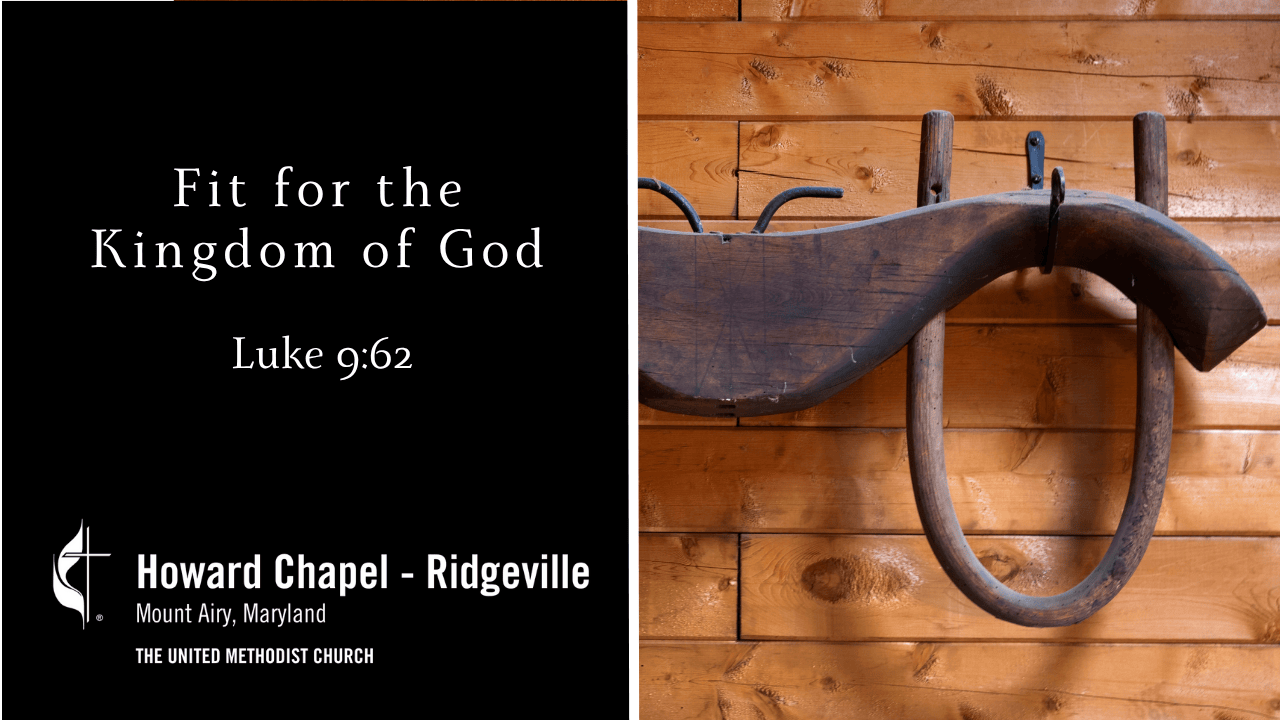
But when we’re compelled to love our neighbor at any time, in any place, and at any risk, then this good news of God’s grace suddenly reveals to us the cost of following God’s commands, the cost of discipleship. Following the way of God can be thought of as plowing a row in the field. The row begins at one end and, over time, you move to the end, and hopefully in a straight line without veering off to either side. But sometimes it’s scary to keep going, to keep our focus on the work ahead of us, and we are tempted to turn our eyes away, and the plow turns with us, and we are all of a sudden no longer aligned to contours of the field, the contours of creation, the contours of God’s plan for us.
God’s plan for us: Have you ever felt like God was counting on you to shake things up, to change the status quo, to make a difference in the world?
Sometimes it can be as simple as unplugging your cell phone charger after use so that you save the planet a little more energy. Or maybe it takes more effort, like when my alma mater, St. Mary’s College of Maryland, switched all its energy consumption from fossil fuels to wind power. That took effort and requires continued commitment year after year. And sometimes, it involves a risk. You don’t know if anyone will agree with you, and you’re not sure you’ll live long enough to witness the changes you’re helping to bring about. You’re not even sure if you’ll be successful in your efforts. When have you felt like God was counting on you to shake things up, to change the status quo, to make a difference in the world?
Whatever our reservations, God directs us to attend to the needs of the people. We are a people set apart by God to be a light to the world—to show everyone the innate beauty of living in God’s kingdom. We are called to do God’s will, even if everyone else fails to hear God’s calling, and this is important, no matter the time, no matter the place. It is as important now as it was during Jesus’ day, as it was during the time of the abolitionists, as it was during the time of revolutions from European tyranny, and as it inevitably will be in the years and seasons ahead.
Our calling is important to listen for, no matter the time. Our belonging in the kingdom of God is so demanding of us, that we cannot let our attention be diverted by concerns of how we appear to others, or how we stand to benefit from our social position. Our discipleship is so important that we cannot delay our faithfulness to God’s call to justice, even under the guise of piety or social convention.
Because there are people in this world who are suffering – traumatized and neglected children, fractured families, callous elites, outcast individuals who are told they bear no worth in the eyes of God. There are people in this world who are suffering. And God is calling us to be the avenue of love and grace for them, with them, and among them. God has a plan for you and for me and for this world, to set our eyes on our destiny, to walk toward it boldly, to leave behind our security and safety, and to “go and proclaim the kingdom of God.” To proclaim good news is to live as one fit for the kingdom.
Will you follow Jesus, too, “to bring good news to the poor … to proclaim release to the captives and recovery of sight to the blind, to let the oppressed go free, to proclaim the year of the Lord’s favor” (Luke :18-19), the year of jubilee? I pray you will. Amen.

Leave a Reply