
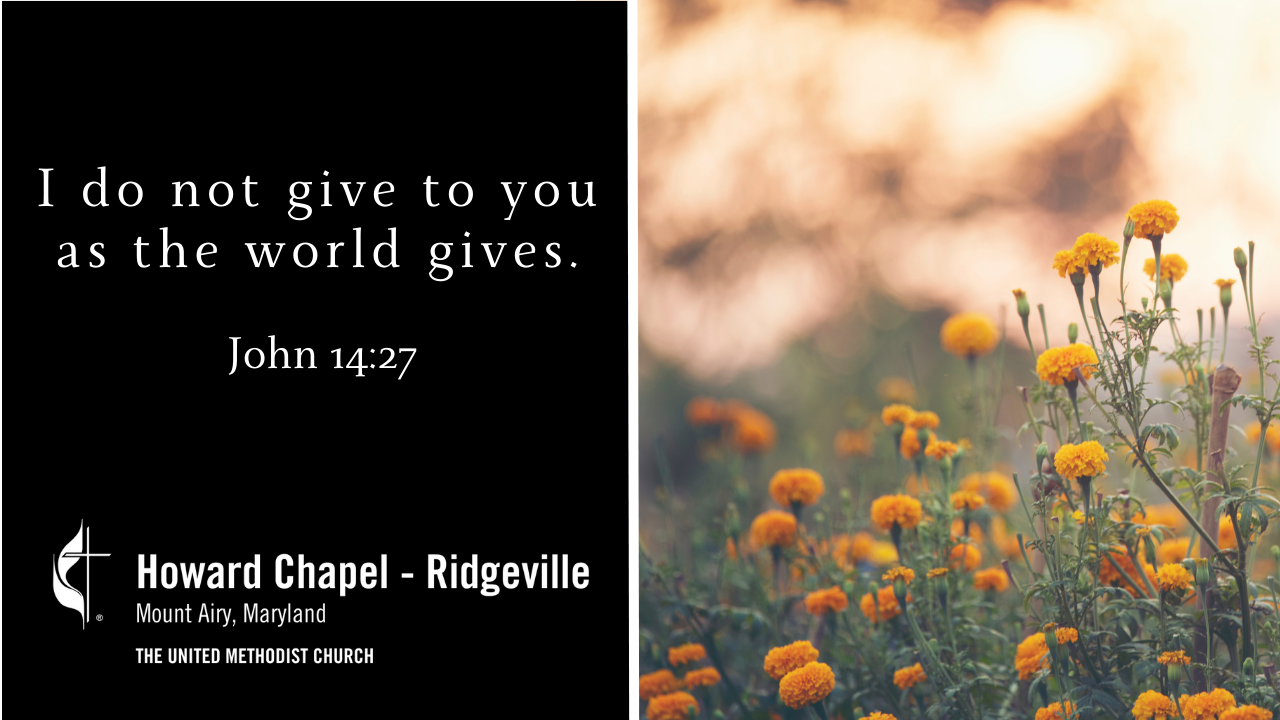
This Gospel lesson is one among many in the Bible concerning peace and forgiveness, anxiety and aggression. Christians are a people of the Book, following a religion of redemption, of new beginnings. And the entire story of God and humanity is one of God rebuilding our relationships after we’ve gone and mucked them up, again – again and again.
In this season of Easter Sundays, it’s funny to me that the reading would come from a section of a goodbye address, something that Jesus said to the disciples on the night of the Last Supper. That’s why the imagery from this Sunday and the last are of gardens and vines, reminiscent of the surroundings of Jesus his final night in the Garden of Gethsemane, with little more than pinpricks of light to illuminate the paths of the would-be disciples on the most harrowing and painful occasion of their wanderings after their rabbi. I wonder why the people who planned the readings for this season didn’t choose something that more readily lends itself to something more of a mission statement or something that can be characterized as inaugural.
These words are some of Jesus’ last before his wrongful arrest, police brutality, unlawful detention, and state execution. For the early church, there must have been a bittersweet memory for disciples when they recalled and shared aloud Jesus’ sayings of peace and forgiveness, Christ’s warnings against anxiety and aggression. And because this promise is shared in scripture, Jesus’ gift of peace is not just conveyed to the first disciples, the first followers, the ones who betrayed him, denied him, and misconstrued his every teaching to the end.
These words – “my peace I give to you” – are powerful enough to continue to hold sway over the Church, from one generation to the next, even as we grow further and further removed from the revelation of God in Jesus, that direct, personal encounter with the man who walked the dusty roads of Nazareth. Even we, “who have not seen yet have believed” (20:29), are promised something otherworldly from the One who is not of this world.
I love those words: “Peace I leave with you; my peace I give to you. I do not give to you as the world gives. Do not let your hearts be troubled, and do not let them be afraid.” There are other passages in John which speak to me. Earlier during the Supper, Jesus bends down and washes the disciples’ feet, saying “if I, your Lord and Teacher, have washed your feet, you also ought to wash one another’s feet. For I have set you an example, that you also should do as I have done to you. Very truly, I tell you, servants are not greater than their master, nor are messengers greater than the one who sent them. If you know these things, you are blessed if you do them” (13:1-35). He says much else to that effect, that we ought to bear with one another and share in each other’s lives. Will we listen to the words of Christ and allow ourselves to live according to God’s way of love?
As far as we know, the early church listened. They met regularly and often, shared things in common, and had meals together. They worshiped God in community – not on their own, in their living rooms, by themselves, sitting and watching a televangelist or grumbling about the people in the pews and the pulpit that they just can’t stand. They worshiped God in community. They sought to serve one another, learning as they went.
You and I are still learning, today. We experience the same set of heartaches as we go about our daily lives. Whether it be fatigue, frustration, pain, grief, shame, anxiety, or guilt, we have to agree that our lives are, at the moment, far from perfect. There are many times throughout the day that I wish that when Jesus said “Come to me, all you that are weary and are carrying heavy burdens, and I will give you rest” that he meant we would find physical rest for today, and not the spiritual rest for our souls that he seems to have promised. Or when he said “do not worry about your life, what you will eat or what you will drink,” I wish he meant that he would take care of getting the groceries.
But maybe, maybe I could just be taught to worry a little less about mundane things, things that don’t matter at all when it comes down to it – things that are just inconveniences. That really would be nice. I think we all would like to be more detached, unbothered by people who throw accusations and cast aspersions our way. I would like it if everyone were able to see each and every person as a child who needs to be patiently loved – rather than as some arrogant, combative, adult fully accountable for her actions. Holding people accountable is one thing, and seeing their heart, having empathy, seeing why they are the way they are is another. I would like to be able to see in each person I meet the wounds they carry from the bumps and scrapes of this world, as well as the kind of potential that God sees in each of us.
What about you? Do you find you are easily aggravated, set off, flying off the handle, yelling and screaming, perhaps even calling someone the devil in your mind, all while you are asked to take a look at yourself in the mirror? Or are you quick to circle the wagons, to shun strangers, and ignore sources of wisdom, even if it means missing the presence of Christ among you, Christ revealed in a newcomer, Christ revealed in someone you perceive as an enemy, as unwelcome, as foreign, as rejectable and expendable? What cause for fearfulness makes us so defensive and so inhospitable?
The week at Annual Conference, I got to share a table with a colleague, who is the pastor at Trinity United Methodist Church in Frederick. Sitting in her company reminded me of a story of hers about one of her classes in seminary. The class was held at the women’s prison in Clinton, New Jersey, with half the students composed of women from the seminary, while the other half of the was made up of women in the prison. They called themselves “outsiders” and “insiders.” It was a powerful experience for her. She reflected:
The women in the class walked alongside [her] on the road throughout the semester, and showed [her] great hospitality, even though [she was] white, college educated, middle class, from a loving family, with a loving partner – and many of them were not. [They] did not talk about why many of the women were in prison because it is seen as intrusive, but some women were open about it. [My friend] sat next to a woman in class who killed her abusive boyfriend when he finally threatened her son’s life. She went into prison when her son was four, and [by that point, he was an adult]. And this was the same woman who always had a big smile for [my friend when she] came into class.
The women in the class, both insiders and outsiders, opened [my friend’s] eyes to seeing God in new places, like within the khaki uniforms of incarcerated women. Driving from Clinton after class every week, the other outside students and [she might have said] to one another, “Weren’t our hearts burning inside us as this one talked to us on the road and explained the scriptures to us” (Luke 24)?
I wonder if you have recently had any experiences like that. They lead to a new perspective on what people are going through. But maybe, at times, you feel more like you could be surrounded by strangers and, for some reason, your eyes would be kept from recognizing something of God in them. And that’s understandable, because many of us have been on our own for so long, we have had little company or involvement with others. We have been swimming in our own anxiety about our own health and the health of loved ones. Perhaps we’re having trouble sleeping, or sleeping too much, and the same goes for eating and drinking.
It’s hard enough to concentrate on our responsibilities and to maintain a cheerful attitude with people who stop by. People are sinking into lower and lower sentiments about the world, falling into deeper bouts of depression, obsessive tendencies, or other mental health conditions, exacerbated by the continued disruption of social norms, shocks to our finances, threats to our employment, and the loss of our friends’ and families’ livelihoods. We are facing stubborn inflation, we are facing tyranny against Ukraine, we are facing genocide through starvation in Palestine, we are facing antisemitism and abhorrent murder in Washington, DC, we are facing xenophobia with the expulsion of students from abroad. We are facing a lot, all the time. And some of us aren’t even watching anymore; we’re just drowning in an increased reliance on ways to avoid or numb feelings of powerlessness, ways which only make our other problems harder, not easier, to face. Where can you find peace?
Peace isn’t hiding from us. “My peace I give to you,” Jesus declares. I pray we stop forgetting the peace of God, which meets us right where we are. It’s a promise that’s so clearly conveyed in the passage about the disciples on their way to linger in the dark of the garden on the eve of their teacher’s murder. Peace given to them, even then, so freely offered. It’s offered to you and me as well.
But we don’t always see it. The disciples didn’t, not at that time. Not even a day after its offer, Peter drew a sword to fight the police. Not one of the disciples gave a moment’s thought to reaching out to Judas, to keep him from taking his life in shame and guilt, isolation and regret. How many weeks and months would it take for the disciples to receive Christ’s spirit of peace in their hearts? They didn’t accept Jesus’s peace; they didn’t embrace God’s gift for their lives, not at that time, not in that crisis. What was it? What kept them from seeing clearly? Were they so outraged by their experience, so traumatized, that they couldn’t accept something good? It walked right up to them and presented itself directly to them, saying, “My peace I give to you. I do not give as the world gives,” maybe explaining: I will not burden you; you do not have to pay for this goodness which is shared with you.
What kept the disciples from opening themselves to the goodness of God? What terrible trauma that must have been. Trauma happens to us when we’re overwhelmed by our circumstances, when our life is endangered, and our sanity is threatened. Fear, anger, shame, a feeling of helplessness and vulnerability are a few of our more common responses to traumatic events – when we are reminded that we are not as powerful and capable, as invincible as we thought we were.
When faced with reality, the awareness that we are small, fragile, and easily tossed about by the waves, we can respond to that realization by dwelling in our disappointment, lingering in self-pity and self-absorption, until we become bitter, always hurting, never healed, prone to lashing out at others who remind us of our wounds, rarely gracious or compassionate, often deflecting and rarely accepting responsibility. Instead of transforming disappointment, grief, and fear, we can brood on it and nurture it, so that we will be – in our estimation – stronger and more vigilant, but really, we’re just more callous and guarded. We do not accept God’s peace because it involves admitting and feeling our weakness.
While the disciples eventually walked away from Jerusalem, from the site of their trauma, Jesus’ promise of peace went with them. Even as they rejected God’s gift, even as they lived in the night of their own emotional turmoil and suffering, God’s goodness and mercy followed after them. God’s peace, the peace of Christ given to the disciples, when it was finally received, finally accepted, finally admitted into their hearts, allowed them to reframe their whole worldview – their understanding of God, of sacrifice, and what divine power and might really means: Not smashing one’s enemies who get in the way but denying oneself for the sake of the other, even the gentile, Peter reasoned, even the enemy, Jesus taught, “even the ungrateful and unkind” (Luke 6:35). Jesus’ peace transforms trauma into fresh understanding, rejuvenated purpose, and an entirely new life.
What would happen if you and I could learn to accept God’s peace completely, even on difficult days? What would happen if our hearts were forever welcoming of Jesus’ call to disarmament and beating swords into plowshares? How would God’s peace transform our trauma? It’s worth exploring.
One way we can begin to allow God’s peace to wash over us is by writing down the details of the day. Take a notepad, or a journal, or an app on your phone, and write throughout the day what’s happened. It may seem mundane. But it will be easier to write periodically, one sentence about the past hour, than to write a page at the day’s end. After you spend a few days this week writing, look for patterns. Did you seem happier when you were contemplating a family member under your roof, or talking to a loved one on the phone, or contributing to a worthy cause, or feeling the sun on your face?
You might discover a new appreciation for life. Or you might reevaluate your priorities, how you spend your time. You might realize you want to cut back your hours with one task to devote more time to a different one. Or, you might want to cultivate a new hobby, a new passion, something you are discovering you not only have time for but interest in – all as you look at what you’re doing with your life, not through the lens of panic and urgency, but from the place of peace and acceptance that comes from God’s Spirit dwelling within you.
That spirit of peace might empower you to learn to be able to sit with yourself and with others in their grief and worry. And you might understand your own need for help and company more clearly, being able to accept it more freely, because you also are incomplete without the care of others and of God watching over you.
When Jesus says, “my peace I give to you,” it’s not the kind of peace that arises from sitting on the porch for a morning, sipping coffee and watching the pelicans dive under the ocean waves for breakfast. It’s not the kind of peace that comes from an hour of meditation surrounded by candles, crosses, and potted flowers. The peace of Christ, the union with God, is the utter absence of being at war with God, the release from being pursued by a vengeful and vindictive God, the freedom from being convinced and convicted of impending doom. Instead, the peace that Jesus offers is the affirmation that Christ is in the Father, and we are in Christ, and Christ is in us. And I cannot imagine any greater wholeness, any deeper completeness, than that.
I would love to have this kind of assurance every day. We don’t have to wait for it to come our way. We have already been brought into Christ’s peace. We are already incorporated into God’s love. And we get to witness all things being made whole – even the things inside ourselves, even the things we think are irreparable. We have no reason to be afraid anymore, no reason to let our hearts be troubled. Because we belong to God. And Christ’s peace is ours to keep. Will you keep Christ’s peace in your life, and allow it to transform your trauma into something new? I pray you will. Amen.

Leave a Reply