
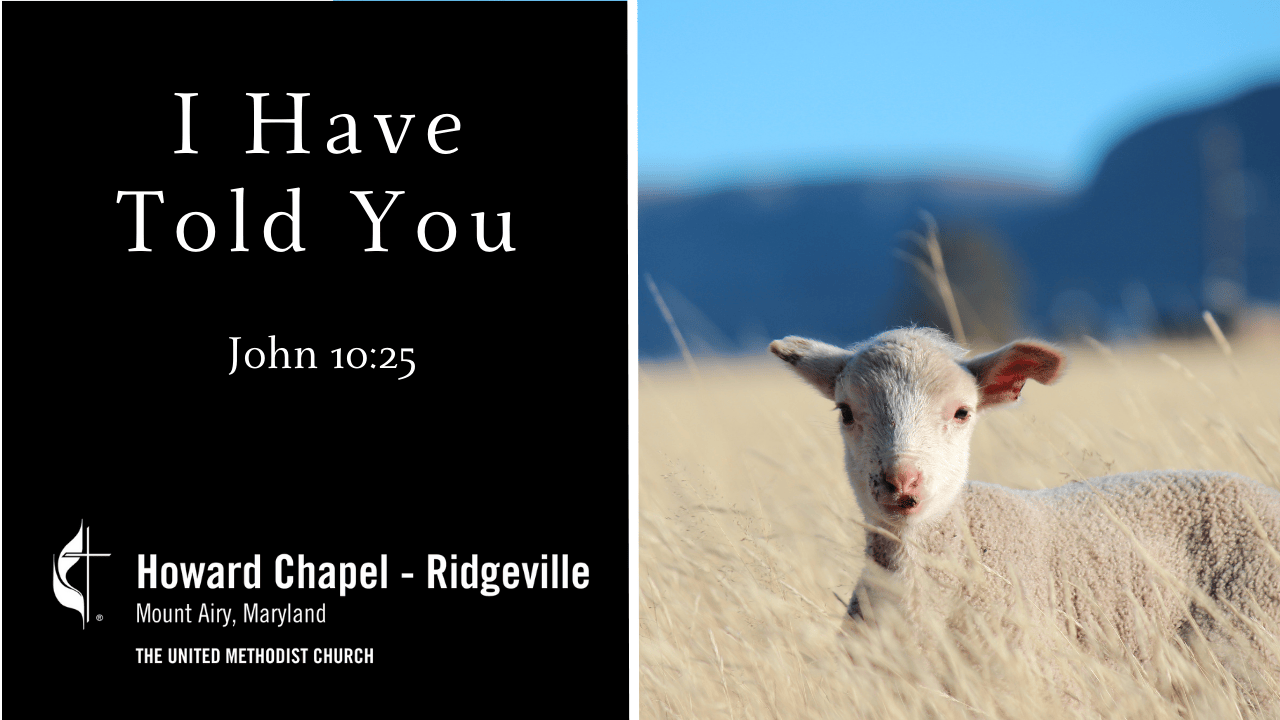
What do you make of this interaction? The authorities questioned Jesus, ordering him to tell them plainly if he was the messiah. He replied: “I have told you, and you do not believe. The works that I do in my Father’s name testify to me, but you do not believe because you do not belong to my sheep. My sheep hear my voice. I know them, and they follow me.”[i]
It’s wild that some people need no proof to believe a lie but demand endless proof to accept the truth. Jesus tells them and us and everyone the truth. Some who hear him follow him. Others who hear him ignore and reject him altogether. Which ones are we, on the whole? No one can be perfectly devoted to God every second of every day. No one can be perfect. Many of our choices are at odds with each other. We act one way at the start of the day, and at the end we look like a completely different person. So, in absolute terms, we are a muddled mess. But, generally speaking, would you say we are disciples, or are we pharisees?
Are you and I so certain that we would be the sheep who are part of his flock? Are we sure that we would never find ourselves calling “good evil and evil good,”[ii] as the prophet laments?
Say we do it right. Maybe we are the ones who have the correct doctrine, the proper words and postures for the celebrations of the sacraments, and the appropriate practice of our faith. What does that say about your brothers and sisters in Christ who see the world differently from you? Would you assert that they are like the pharisees in the Gospel, and you are like Jesus’ followers? Would you put that much distance between them and you? I hope not.
But sadly, I’ve heard from too many Christians in this denomination and in this country that they are the only ones who are correctly following Christ. They’ve taken the time to write me multiple personal emails, or send me form letters by post, or call my church office phone to correct me on the covenant God makes with Noah and importance of rainbows. In their eyes, anyone who disagrees with them is a heretic, or a sinner, or a political extremist, or a puppet for a fallen and godless culture. I can’t be the only person here who has heard these comments. They see things in black and white, and they filter people into two categories: right or wrong, in or out, saved or damned. Do you put that much distance between others and yourselves? I hope not.
The fact is we find ourselves at odds with each other. We are in deep disagreement about how to see the world – either from the left or from the right, in absolutes with absolutely no nuance. We are neighbors who have been torn apart.
This week, the United Methodist Church released a ruling on church law, affirming the pastor’s sole discretion in conducting a wedding in a church building, without regard to the objections of the church’s trustees. You can imagine a couple whose union might be looked down upon, and the congregation might object to the use of the sanctuary to celebrate the covenant they make with each other. Maybe they’d suggest the pastor officiate the wedding at a vineyard or some other venue rather than use the church building. Either way, the church would offer no ushers, no greeters, no custodial support, if the pastor held the wedding in the building.
In decades past it could easily have been a marriage between people of different ethnicities that would have drawn a strong reaction from a typical, homogenous church. Nowadays it might be a wedding for two people of the same gender that would be as divisive.
Progressives hailed the Judicial Council’s decision, because it allows for clergy to follow their conscience. Conservatives saw this interpretation of the Book of Discipline as a win for denominational “buearcracy [sic]”[iii] rather than for faithful discipleship.
The timing of this ruling could not have been worse.[iv] Over this next year, including this coming week in Baltimore, annual conferences around the world will vote on whether or not to allow the United Methodist Church in the United States to govern itself by its own delegates, rather than rely on a general (global) conference of delegates to govern its laws pertaining only to this country. The change would make it easier for churches here to be responsive to the culture and needs here, rather than remain bound to the cultural attitudes and beliefs of delegates from other countries. Conservative United Methodists around the world are already up in arms over this decision from the Judicial Council. So what if they vote to retain control over the church in the United States? What if they take stories like this one as a rallying cry to do whatever they can to impose their sensibilities on Christians in the United States, on people like you and me? We are torn apart as a denomination, still.
We also saw this week the Catholic Church affirm the movement of the Holy Spirit in the ministry of Pope Francis, by the election of Cardinal Robert Prevost to be his successor. You know by now he was born in Chicago and is the first US pope. A prominent historian shared her analysis of the election:
He spent much of his ministry in Peru and became a citizen of Peru in 2015, making him the first pope from Peru, as well. … Prevost has chosen to be known as Pope Leo XIV. This is an important nod to Pope Leo XIII, who led the church from 1878 to 1903 and was the father of modern Catholic social teaching. He called for the church to address social and economic issues, and emphasized the dignity of individuals, the common good, community, and taking care of marginalized individuals.
In the midst of the Gilded Age, Leo XIII defended the rights of workers and said that the church had not just the duty to speak about justice and fairness, but also the responsibility to make sure that such equities were accomplished. In his famous 1891 encyclical Rerum Novarum, translated as “Of New Things,” Leo XIII rejected both socialism and unregulated capitalism, and called for the state to protect the rights of individuals [regardless of wealth or status].
Prevost’s choice of the name Leo invokes the principles of both Leo XIII and his own predecessor, Pope Francis. In his lifetime he has aligned himself with many of Francis’s social reforms, and his election appears to be a rejection of hard-line right-wing Catholics in the U.S. and elsewhere who have used their religion to support far-right politics. …
As an American-born pope in the model of Pope Francis, Pope Leo XIV might be able to appeal to American far-right Catholics and bring them back into the fold.[v]
I think that would take a miracle, an act of God, given how torn apart we are, in how we view the world around us. That worldview centers us instead of God. It puts our own desires and preferences first, instead of allowing compassion to lead us where we need to go. In the words of a spiritual writer and environmentalist, Wendell Berry, penned in 1969:
We have lived by the assumption that what was good for us would be good for the world … We have been wrong. We must change our lives, so that it will be possible to live by the contrary assumption that what is good for the world will be good for us … We must recover the sense of the majesty of the creation and the ability to be worshipful in its presence. For it is only on the condition of humility and reverence before the world that our species will be able to remain in it.[vi]
It’s difficult to turn from one disposition to another, from self-centered living to living out of love of our neighbors. We are torn apart, not only from one another in our political views but also torn apart in our hearts. We are wrestling between our proclivities and our ideals, between our allegiances to our leaders and our social norms on the one hand and the voice and the words spoken by our Savior on the other. That is a position that no one wants to be in.
As a pastor, I’d exhort you to listen more closely for the voice of Christ and to allow it to direct how keenly you follow your heart’s capriciousness, your political party’s calculating power seeking. How else can we temper our partisanship in this country? How else can we learn to work together even with the people who think differently from us? How else can we each agree to call good good what we each see is good and not rush to demonize the other who sees the world in a way we don’t?
It is by finding our belonging not in the tribes of Fox News or the New York Times but in the love of God, and the power of the Holy Spirit, and in way of Jesus Christ. All of us have a home there. All of us have belonging.
We belong in Christ, to our Good Shepherd. On this Mother’s Day Sunday, we give thanks for the people who have formed in us a sense of ourselves, a sense of the world around us, a belief that we can love and be loved, a degree of faith in the people in our lives. We give thanks for the people who showed us what it is to give of ourselves for another. They point the way to the source of love and the lighthouse of truth.
And, on this day, when so many people cannot help but recall the shortcomings of their parents, when so many people are longing for someone to have loved them the way they deserved to be loved, we pray that by God’s grace we would be able to patch each other up, to help one another become more and more secure in themselves, in Christ’s love for them, and in the world’s acceptance of them as they are.
As a beloved and loving people, as people who are self-giving and nurturing of others, may we embody care and concern for one another in this community, in our country, and in our world, as we seek to follow Christ’s teachings and listen for his leadings, this day and every day. Amen.
[i] John 10:25-27, NRSV
[ii] Isaiah 5:20, NRSV
[iii] United Methodist News, May 5, 2025, https://www.facebook.com/share/p/16KjUbYfYR/
[iv] Heather Hahn, May 5, 2025, UM News, https://www.umnews.org/en/news/bishops-respond-to-same-sex-wedding-ruling
[v] Heather Cox Richardson, May 8, 2025, https://www.facebook.com/100044557238708/posts/1230364261792137/
[vi] Wendell Berry, The Long-Legged House, 1969.

Leave a Reply