
Palm Sunday is a beautiful day in the church calendar. And nature seems to agree. The blooming yellow daffodils and red tulips, and the violets on the ground, make a brilliant array of fresh color after a winter of brown and gray.
This spring, the dark of night no longer lingers into the morning hours, and the sound of birdsong before dawn is just beginning again. Bees are exploring my yard, and young rabbits are hopping along the undergrowth. The summer will soon come, and the blossoms on the cherry trees fall to the ground to make room for new leaves to soak up the sun’s light.
But the sun rises, and the days grow warmer. The mornings begin to hint at a changing of the seasons. Patterns of frost on leaves of clover now give way to drops of dew and spring showers.
How will we fill it? How will we spend our springtime days, days growing full and soft with life abounding? Will we spend it grumbling, churning in bitterness, complaining to God and anyone who will listen, casting ourselves as the only victims of this past year? Will we pile on our tragedies to outsized heights, and will we refuse to see the sun rising and feel the warm breeze? Will we remain dormant in our winter dens, the places of stillness and loneliness to which we’ve grown accustomed these past few years?
Or will we reach out and take hold of our lives in a new way? Will we reestablish friendships and relationships that went quiet over the winter months? Will we resume our responsibilities? Will we turn our attention to the wellbeing of others? Will we seek the healing and health of our communities? Will we step out into the spring mornings, bathed alternately in sun, wind, and rain, and tend to the gardens given to us?
Because the Lord needs you. The Lord needs your energy. The Lord needs your compassion. The Lord needs your willingness to go where God leads, which is always to the truth, always to the water of life, always to a better way of seeing the world.
The Lord needs you – all of you – all of your heart, all of your love, all of your devotion, all of your life. The Lord needs you to bear God’s presence, God’s light, God’s grace and providence, to a world that does not comprehend God’s goodness, does not recognize “the things that make for peace” (Luke 19:41-44). The Lord needs you to be a part of the transformation of creation, to take up your place in God’s plan of healing and reconciliation for us all. The Lord needs you.
It is a gift and a task[i] to be asked, to be needed by God. All who take Christ’s name also take on a ministry, are gifted by the Holy Spirit, to accept a mission of unstinting service, and are graced by God with the promise and presence of the Spirit (Ephesians 1:13), the possibility of a full and abundant life – not a long life, not a pleasant life, but a full and abundant life, spent in greater clarity and deeper honesty than we can manage on our own.
The service to which we are called is one toward the wellbeing and flourishing of the whole human community. And it’s a service no individual can accomplish on her own. We all need each other, each other’s gifts and graces, each other’s insight and perspective, each other’s particularity and witness.
It’s difficult to rely on others. We like to believe we can accomplish our goals without being helped, without being healed by the friendship and fellowship of our neighbors. We want to be magnificent and magnanimous in our way of life. We want to be graceful and strong, always gracious to those others who need our help. We like to be looked upon with wonder and admiration, respect and deference.
It’s easy to take comfort in grandeur and a spotless reputation. It’s easy to think that, once things look a certain way, and everything is in order, and every person is where they should be, with every hair in place, then, we will be able to face the world’s grief and our own. It’s less frightening for us to do that, to dream with our heads in the clouds, than it is to admit our own pain, and deal with it without any strength of our own but what comes from God alone.
Maybe that dream of grandeur was the hope of the people in Jesus’ day, when they raised palm branches and shouted Hosanna. In their time, the Temple had been desecrated by various occupiers – including the Greeks and the Romans whom we revere today. They had erected statues of Zeus and Jupiter in the Holy of Holies and slaughtered pigs, unclean animals, on the altar. After an abomination like that, it’s only natural that the faithful would want to make sure the Temple’s glory is protected.
They’d want a mighty king who had what it would take to stand up to the Roman Emperor, to be a strong man and a fighter. They’d want a king riding on an impressive warhorse into the city, followed by legions of men, and they’d want him to command the respect of all the heads of households of the land gathering for Passover.
The patriarchs had come together from all the tribes of Israel to assemble in the country’s seat of power, the city of Jerusalem, for a feast instituted to remember, and retell the story of, Israel’s deliverance from imperial oppression and bondage in Egypt, Israel’s redemption by God, Israel’s victory of the Pharaoh and his armies. The story that is told and retold is that the firstborn of Egypt were killed by God, and the people of God found deliverance through violence and death. The people wanted a leader to do for them what they recalled happened in Egypt. That was their hope.
So the prophets rode in a parade, a procession, through the city gates. They looked respectable and pious, proud, and worth following. They attempted to give dignity to the city of Jerusalem which had been defiled and disgraced. And everyone knew that was the story they wanted told.
So Jesus was a disappointment and antithetical to their hope for a strong man to save them. Jesus was a homeless, itinerant rabbi from a no-name town, riding ungracefully on a colt that had never been ridden, entering the city alone but for twelve followers, and eventually withdrawing from Jerusalem for the night, because he was not accepted by any great household within the city walls.
Despite the welcome with palm branches, Jesus does not meet the expectations of the people. Because the people could not find the courage they needed to look within themselves for the strength God had given them to face the world they were in, they wanted a messiah to do it all for them.
Sometimes we behave the same way: We want a strong, decisive leader. And in our longing, we might begin to think that we can be – at least on the outside – that kind of messiah for others, the strong one who can handle all burdens, the one who can manage the pain and trouble of others and take care of everything people need, the person who can be called on to lend a hand, even when we don’t think we have much energy left. But when we’re stressed out, when we need a friend to talk to, when we are worried how things will turn out, I wonder how often we actually do turn to our neighbor and ask for help. Because it’s tiring, keeping up appearances. It’s lonely, too.
So I give thanks for a God who sees past our false bravado, our veneer of placid content. God names our insecurities. The Creator who knows your name, your worries, your critical self-assessment, also knows you – all you are capable of, all you were created for, all you will accomplish as you walk from one stage of life to the next. We don’t need to be anything other than who we already are. We are creatures of light, living souls full of the breath of God, shining into every corner of our world, eventually coming up against issues and complications we can’t comprehend, and finally, we join the crowd of the faithful, crying out: Hosanna. Save us, we pray.
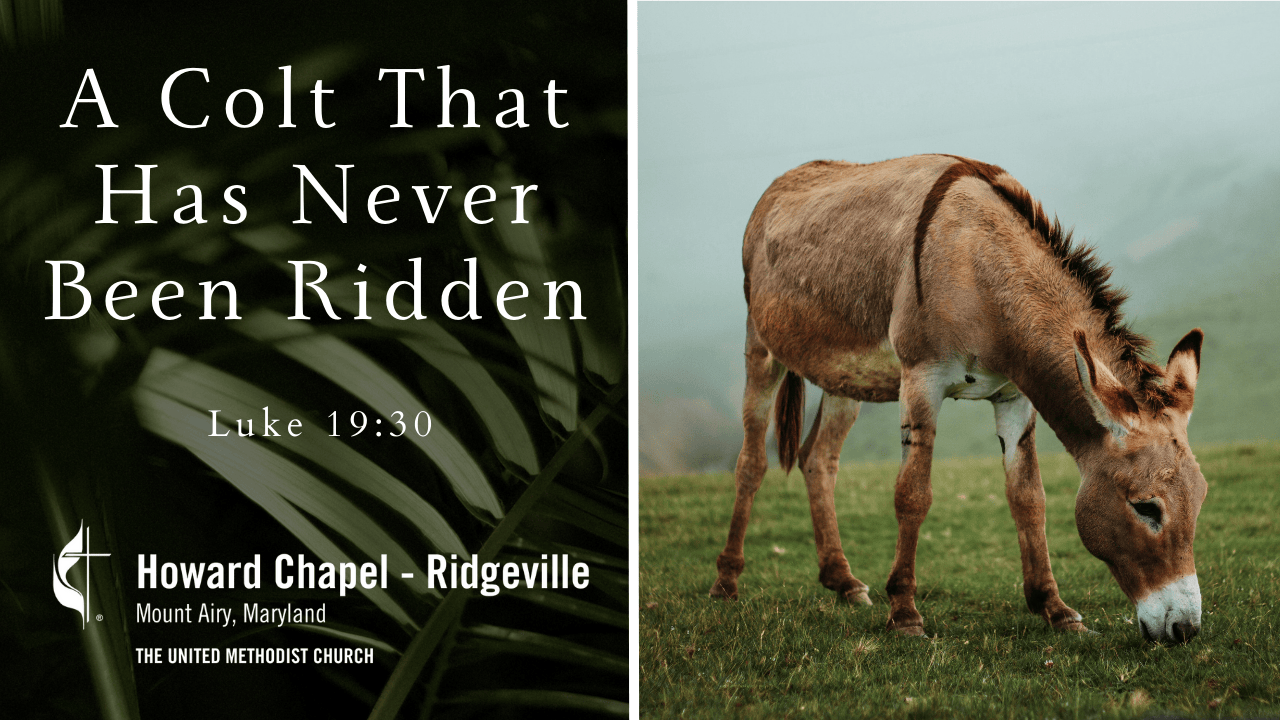
Whatever you’re coming up against, you are wholly adequate: God wants you just as you are, just as Christ presents himself just as he is. Jesus doesn’t promise anyone that he can win a war. Jesus rides in on an unruly colt, one that’s never been ridden before! Have you seen someone try to ride a green horse? I can imagine Jesus, on his path into the city, having to dismount periodically, reassure the animal that it’s alright, and then try to continue on his way. It’s a miracle that he made it all the way into the city! It’s a miracle: an act of God. Jesus’ posture as he rides on a foal is one of dependence on God, dependence on something other than himself.
Palm Sunday is a reminder that we rely on God, too, whether or not we acknowledge it. In the actions of Jesus Christ, we see that it’s okay to approach and enter the Temple without having to project an image of complete control. And that is the good news.
We don’t have to posture, to front, to present an appearance of stability or tranquility, vitality or superiority, to come off as having everything together and not needing any help from anyone. Because that just leaves everyone feeling inadequate, and no one knows that they can rely on their neighbor for support, and everyone just comes to church to sit stone-still (with every hair in place), all the while feeling all alone.
So this final, Holy Week of Lent, instead of pursuing fasts and devotionals, I beg you as I stand in this pulpit, to please reach out to a loved one or a trusted friend, and to tell them this story of Jesus’ honesty about who he is and how God fills in the gaps for us, and to be vulnerable yourself, and maybe to discover that you can be accepted for who you are, exactly as you are. Because God’s love is so enduring, so complete, so immutable that it will never be suppressed. And God bears this love for you.
And that is good news. So it makes all the sense in the world to wave palm branches and sing Hosanna, for the Lord, who in his triumphal entry into Jerusalem, did not carry a shield or helmet and did not brandish a sword or a spear. The Lord chose a donkey, unridden before, unused to service of this kind, unsettled by the crowds of the procession, uncomfortable with the attention directed its way. But the Lord needed it, needed this novice animal. And perhaps by some power of heaven, the donkey obliged, and bore its great burden with what inexperienced and untrained grace it could muster, and took its place in the great plan of God to change the world.
So I ask you: In your vulnerable and honest imperfection, to what task or place might God be calling you? Will you allow yourself to be untied from your obsession with reputation and independence, unbound from your hesitation and disbelief, so that you can be released into the service of the Lord? Will you relinquish your doubts and misgivings, your brooding and grudges? Will you consent to be governed not by your own self-gratification but by the will of One who cares for all the world, the One who knows you and understands all your faults, the One who knows you have a place in the procession that shames the powerful and uplifts the lowly, the One who needs you, just as you are?
Will you give of yourself when God calls, even if you’ve never done that sort of thing before, all because, the Lord needs it?
I pray you will.
Amen.
[i] The Book of Discipline of The United Methodist Church, 2016 edition. Nashville, Tennessee: The United Methodist Publishing House, 2016. ¶ 129, pp.98-99.

Leave a Reply