
This world is filled with uncertainties. How well will a crop perform? How gentle will the storms be? How healthy will a baby be? How long will a life be? This world is filled with uncertainty. So you see why this world is filled with people who want power to protect themselves, their possessions, their comforts, their way of life.
Some people saturate their lives with spectacle, as a kind of proof that their days are well spent, and people applaud them, and their reputation is manicured. But that’s not real power. Other people like to shop and consume, chasing after an illusory sense of wealth, hoping to fill their insecurities with adornments and coveted treasures, but, again, that’s not real power. Some people like to be in charge and humiliate others who displease them, and they think that their efforts will lead to obedience from others, but, you know, that’s not real power. You’ve seen people obsess over the functioning of markets, as if their worth and security derive solely from how much money they control, but you also know that’s not real power. Some people will do whatever they can to enrich themselves, even at the expense of the most vulnerable, but that’s not real power. Power that matters is kindness, graciousness, goodness, hopefulness, wonder, possibility, and commitment.
Christ knew this. He had it in mind when he stood before Pontius Pilate, accused of starting a rebellion against the Roman Empire, accused of claiming kingship over his people, accused of stirring up controversy in order to unsettle the peace and undermine the authorities.
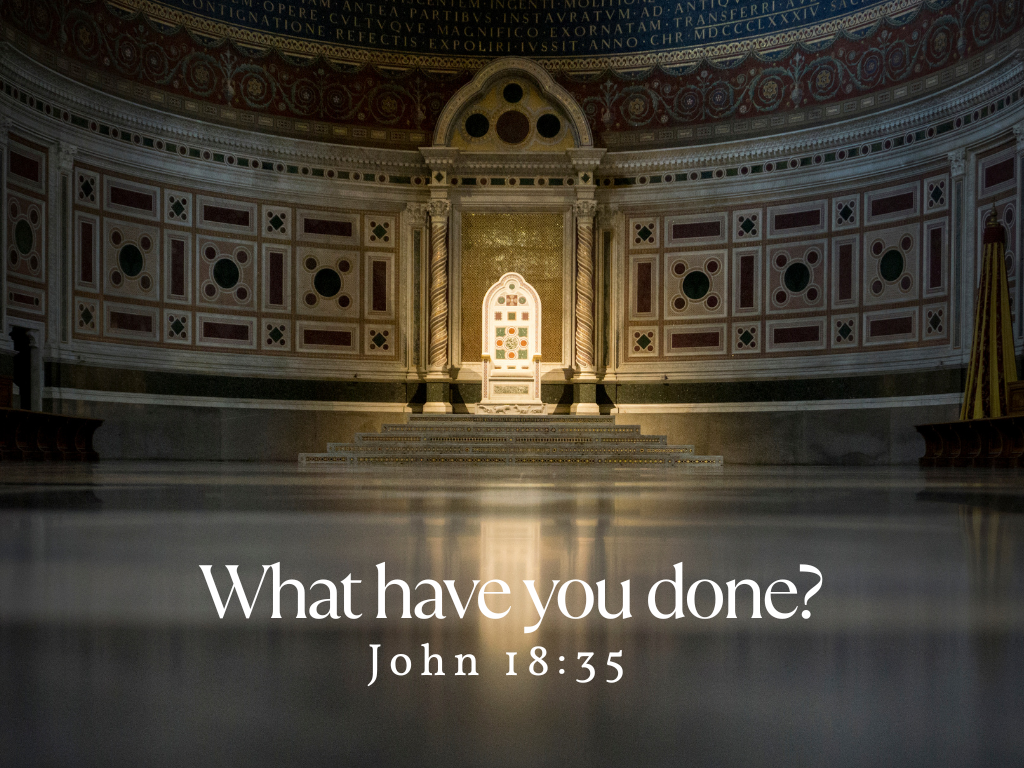
Pilate asked Jesus: What have you done?
And Jesus stood before this man who was authorized to take life or to spare it, and declared to him: The discretion Pilate wielded, the control he thought he had, was nothing compared to the kingdom, of which Christ is the initiator and perfector – a kingdom not from this world, the kingdom of heaven. The things that matter, then, now, and always, are kindness, graciousness, goodness, hopefulness, wonder, possibility, and commitment.
Do we believe this?
Pilate didn’t just question Jesus. In the following chapter, he questioned his captors: “Shall I crucify your king?” And they replied: “We have no king but the emperor” (John 19:15). The confession of fidelity to the Empire, of loyalty to Rome, had a double meaning to John. Their statement seemed not only to refer to Jesus but to the Lord as well. Usually on Passover, the people of God recognize God’s deliverance from tyrants and despots, Pharoahs and Emperors. Year after year, on Passover, zealous revolts broke out in Jerusalem against the occupying forces of the Romans. The rebellions were efforts to reestablish their sense of God’s authority over their land. To swear allegiance to the emperor on a day like that had overtones of forsaking their God. People of every age face the same question: Are the authorities the ones who are the ultimate rulers over our lives? Or do we live with the truth that Jesus is Lord?
“Jesus Christ is Lord”[i] was a statement of faith for the early church. It was their creed. It was a deliberate act of rebellion to the established order, which acknowledged Caesar as Rome’s Son of God, God incarnate, Lord, Redeemer, and Savior of the world. That language was Rome’s propaganda. But the Gospel writers recorded that these accolades properly belong to Jesus, who was not born into the seat of power. He was by all accounts the illegitimate son of a common carpenter. We cannot ignore the social position of Jesus of Nazareth, a man who grew up away from the center of Judaism and who, with all of Israel, was living under Roman occupation. Jesus’ identity reminds us that God can work in the least of all likely scenarios to bring about a new kingdom on earth, subverting and outlasting one established order after the next.
If we want a biblical faith, if we want to be like the churches of Paul, who repeated the refrain, “Jesus is Lord,” then we have to recognize that our religion cannot be beholden to the agendas and whims of the world. Because our world doesn’t always get it right, and we can’t just go along with it. The things that matter, then, now, and always, are kindness, graciousness, goodness, hopefulness, wonder, possibility, and commitment.
I have the joy of having having seen you act like Jesus is Lord in the way you open your hearts to communities you’ve never visited, to neighbors you’ve known for decades, and to everyone in between. Your faith reminds me of the miracle I saw in the first church I served as a pastor in Baltimore.
They were wonderful at welcoming newcomers, which has not always been the case in Baltimore churches. The city has a sad history of redlining, the effects of which continue to disenfranchise entire neighborhoods. The church building is located in Homeland, a neighborhood that was rated in 1937 as “A-1,” highly desirable.[ii] That rating meant that it was unlikely that people of an ethnic minority would move into the neighborhood.
Moreover, it was improbable that people who did not belong to the neighborhood would belong to the church. For that reason, in 1927 the congregation sold its previous building, which stood at the corner of Lanvale Street and Carrollton Avenue, near the Sandtown neighborhood in Baltimore. Minutes from the meeting state their reasons plainly: “due to changing conditions of its members moving to suburban sections and the invasion of [an African-American] population, the value of the service to the community was rapidly declining”[iii] in their distorted and prejudiced view. The congregation merged with Roland Park M.E. Church and eventually built the current large facility in the heart of Homeland. This kind of story is not unique to Grace Church, but it illustrates how far we have come as a denomination.
But on Sunday mornings, the homogeneity that once was highly sought was now nowhere to be seen. Visitors to Grace Church could find an immediate welcome from ushers, volunteers, the pastors, and the community. They could learn that their gifts are valued, that their stories are listened to and shared, and that their presence and perspectives are celebrated. At Grace, I got to see a church that understood the importance of welcoming all people – not just the people one would expect would fit in – but all people searching for God in their life.
I have seen the lordship of Jesus Christ overcome a history of exclusivity and judgmentalism that is sadly part of so many congregations’ stories. And I believe that we, as a community that is learning more and more to listen to God’s promptings, as a church that is practicing more and more what it might look like to welcome newcomers, we can only grow.
Belief in an unseen future and imagination of what might come our way flourish from our faith in God. I remember a scene from the movie Shawshank Redemption. It was released 30 years ago. Its lead character, Andy Dufresne, who was wrongly convicted and sentenced to a life behind bars. But he wandered through the prison yard with, what his friend described as, “a quiet way about him, a walk and a talk that just wasn’t normal around here. He strolled, like a man in a park without a care or a worry in the world, like he had on an invisible coat that would shield him from this place.”[iv] I think about that scene. I think about that shield of faith.
Faith from God is a gift. With it, we are given a chance to live with a kind of double awareness, with both an understanding of the world as it is – with its uncertainty, pain, abuse, grief, injustice, and callous wariness – as well as a vision, or a dream, of how it could be. And we’ve heard lots of dreams through the years.
The Rev. Dr. Martin Luther King, Jr., famously shared his dream of equality on the steps of the Lincoln Memorial in 1963, a dream which at the time, you may remember, seemed threatening to many and unrealistic to many more, a dream which stood in opposition to the laws of the land and the authorities who governed it. But the dream had a truth to it, and over time, many others found themselves dreaming the same dream, too.
In December, for Advent, the scriptures will point this vision. They record a dream of Jeremiah’s, that one day, God would “fulfill the promise … made to the house of Israel and the house of Judah … [and bring about] justice and righteousness in the land” (Jer. 33:14-16).
Isaiah, likewise, dreamt of the Lord’s salvation of the people of Israel, even in their exile from their homeland.
John, son of Zechariah, had a vision of a day when “Every valley shall be filled, and every mountain and hill shall be made low, and the crooked shall be made straight, and the rough ways made smooth; and all [people] shall see the salvation of God” (Luke 3:5-6).
And Mary, mother of Jesus, declared that God not only would bring about the fulfillment of promises and the salvation of the people, but that God already had scattered the proud, brought down the powerful, lifted up the lowly, and filled the hungry with good things (Luke 1:51-53). It wasn’t just a dream for Mary; it was already real, if only we had eyes to see it.
The dream comes true, little by little, when you start to live as though the dream involves you – as if it needs you – for it to become more and more self-evident, more and more of an established fact, more and more difficult to ignore. The dream comes true, one person to another, when we each come to our senses, when we see the faultiness in our assumptions, and we awaken to the goodness that comes from God rather than anything that might come from our efforts or our striving after some power that is not real.
The dream comes true, when we examine what’s holding our hearts hostage from the way of God, what’s keeping us bound to our self-interested pursuits, when instead, we could discover for ourselves: just how far the vision of God’s kingdom might go, if we allow it to lay claim to our hearts, as well.
The dream comes true when we let our hearts change, because we realize where we were going before was down a road to our own destruction, a road well-trodden by many before us, a road that is already wide and flat, a man-made highway to oblivion and loss, waste and regret.
The other way, the way of Christ, is narrow still. Few hope to walk it. The path of discipleship is challenging, not often rewarding in the way we would like, and can even lead to suffering for the sake of another. But it’s the way of the Savior. It is the way of the Lord. It is the way of the One who willingly walked in our midst, teaching us how to live and healing us of our afflictions. It leads to eternal life, to everlasting wholeness, in a kingdom of justice and peace, of kindness and grace, that is unabashedly not from this world, a kingdom of which men and women and children dream, a kingdom we as the people of God proclaim, a kingdom you and I look for and hope for, live for and work for, every day, no matter how short the hours of hours of light become.
Will you choose, this day, to be a part of that kingdom? Will you make room in your day to follow your dreams? And will you help others to find their dreams, too? What vision will you work at, that would make someone like Pilate ask you: “What have you done?”
[i] 1 Cor. 12:3; Phil. 2:11; Rom. 10:9.
[ii] Residential Security Map of Baltimore Md., provided by JScholarship, a project of Johns Hopkins University, accessed May 23, 2016 at https://jscholarship.library.jhu.edu/handle/1774.2/32621.
[iii] George Dexter, A History of Grace Methodist Church: 1868-1957 (Baltimore: George W. King Printing Company, 1957), p. 27.
[iv] The Shawshank Redemption. Directed by Frank Darabont. Castle Rock Entertainment, 1994.

Leave a Reply